
0800 772 33 99 — we cover WS3 from our base in Castlecroft, Wolverhampton.
Two things, both from the same van: clearing a drain that has blocked, and putting a camera down one to find out why.
Call now · Request a call back
What we do in Bloxwich
Blocked drains — cleared with high-pressure jetting rather than rods. Drain unblocking
CCTV drain surveys — graded, MSCC-coded, site plan and full video, report back the same day by NADC-certified surveyors. CCTV drain surveys
No repairs, no excavation — so no reason to find work that isn’t there.
Why people here ask for a survey
A drain that keeps blocking. Repeated blockages are a symptom. The survey finds the root, the stepped joint or the broken section causing them.
No record of where anything runs. For a good many properties here the site plan the survey produces is the only accurate drawing of the drainage that has ever existed.
All the reasons a CCTV survey gets commissioned
Why drains fail in Bloxwich
A drain fails because of what is around it, not just what goes down it. Three things account for most of what we log locally.
Large post-war estates on pitch fibre. Blakenall Heath, Mossley and Leamore went up through the pitch fibre era, and that pipe is now past its design life. The older terraces nearer the High Street are shorter, shallower runs on clay.
Pitch fibre deforms rather than cracks. The bore closes gradually, so blockages become steadily more frequent and nothing shows at the surface until it is well advanced. It also cannot be repaired in place.
Coal beneath the lot. The South Staffordshire coalfield underlies the whole area and was worked shallowly, so ground movement adds displaced joints to the list.
That is the reason a repeat blockage here is worth looking at properly rather than clearing again – the cause is usually structural and it is usually visible.
Who pays
Estate drainage is frequently shared between several properties, and shared runs became Severn Trent’s responsibility in 2011.
Areas we cover
Blakenall Heath, Bloxwich, Coal Pool, Goscote, Harden, Leamore, Little Bloxwich and Mossley — WS3.
Reading a survey of your Bloxwich drainage
We cover WS3, and this comes up often enough on Bloxwich property to be worth setting out properly. Blakenall Heath and Bloxwich see it as much as anywhere.
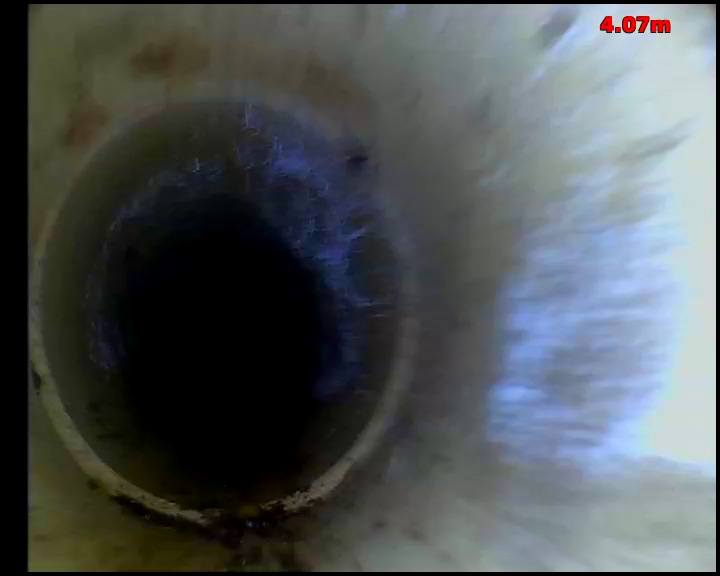
Reports confuse people because they mix two kinds of entry and only one is a problem.
Observations describe what is there – a junction, a chamber, a change of pipe material, the water level. In our surveys these outnumber defects by roughly three to one, and a tidy system with nothing wrong still generates a page of them.
Defects describe something wrong, and carry a severity. It is the severity, not the presence of a code, that matters.
Across every section we have graded, two thirds came back at the top grade. A long report is not automatically bad news.
If it keeps blocking in Bloxwich
Drainage across Bloxwich — Blakenall Heath and the streets around them — follows one pattern. WS3 is what that covers.
A drain that has blocked twice in a season is telling you something structural, and clearing it a third time treats the symptom.
Rodding punches a hole through. Flow returns and the water goes away, but a 100 mm pipe with a 30 mm channel rodded through it is carrying a fraction of its capacity, with the rest of the obstruction still sitting there.
Jetting works on the whole bore. The nozzle scours the pipe wall as it is drawn back, follows bends that rods will not, and takes the run back towards its actual diameter.
Then put a camera down the same run. Standing water hides everything, so the survey is worth doing once the pipe is clear – which is why we do both in one visit.
Clay, pitch fibre or plastic in Bloxwich
It varies street by street in Bloxwich, but WS3 follows a recognisable pattern and Blakenall Heath and Bloxwich are typical of it.
A camera settles what you have in about a minute, and the answer changes what any future work costs.
Clay is the default assumption on older Bloxwich property. It is rigid and brittle: it does not rot, but it moves at its joints, and that is where roots get in.
Pitch fibre is the one that catches buyers out. Coal tar impregnated wood fibre, light and quick to lay, and it loses its round shape under load. There is no single joint to point at – the deformation runs for metres.
Plastic turns up on later runs and extensions. It is often spliced into an older clay system partway along, and our reports carry a specific code for exactly that change of material.
Tree roots and Bloxwich drainage
Around Blakenall Heath, Bloxwich, Coal Pool the housing is old enough for this to matter, and WS3 is where we see it most.
Roots do not break into a sound pipe. The guide printed in the back of our own survey reports puts it plainly: roots normally infiltrate via bad joints, cracks, fractures and breaks. The defect comes first and the root exploits it.
What a root is looking for is water, and a drain leaking at a joint into dry summer soil is an obvious source. A hair root finds the gap, and once inside – in a constant supply of exactly what it wants – it thickens. The root that got in through a two millimetre gap becomes a twenty millimetre root and levers the joint further apart.
Inside the pipe it behaves like a net. Water passes through it. Paper, fat and solids do not. From the house everything seems fine until the day it is not.
Common questions
How do I know if we have pitch fibre? It is obvious on camera within the first few metres, and on the Bloxwich estates it is the first thing we look for.
Nearby: Walsall · Willenhall · Cannock Coverage: Areas we cover across the West Midlands
Talk to the person who will do the work.
Surveys across the West Midlands, south Staffordshire, east Shropshire and north Worcestershire. Unblocking closer to home.