
The expensive version of this story always runs the same way. Plans drawn, quotes accepted, foundations marked out, and then somebody lifts a cover in the middle of where the extension is going.
It is avoidable, and cheaply, but only before the drawings are finished.
Call 01902 475 611 · Book a survey before you design
When you need an agreement
Building Regulations require that a building over or near a public sewer does not damage it or prevent access to it. In practice, if you intend to build over a public sewer or lateral drain, or within three metres of one, you need the agreement of the sewerage undertaker. In this region that is Severn Trent.
Two things follow from the 2011 transfer that catch people out:
- The pipe running down your own garden may be a public sewer, even though it is on your land, if it serves more than one property.
- The length of your own drain beyond your boundary is a lateral drain, and it transferred too.
So “it’s my garden and my pipe” is often only half right. Who owns your drain covers the distinction.
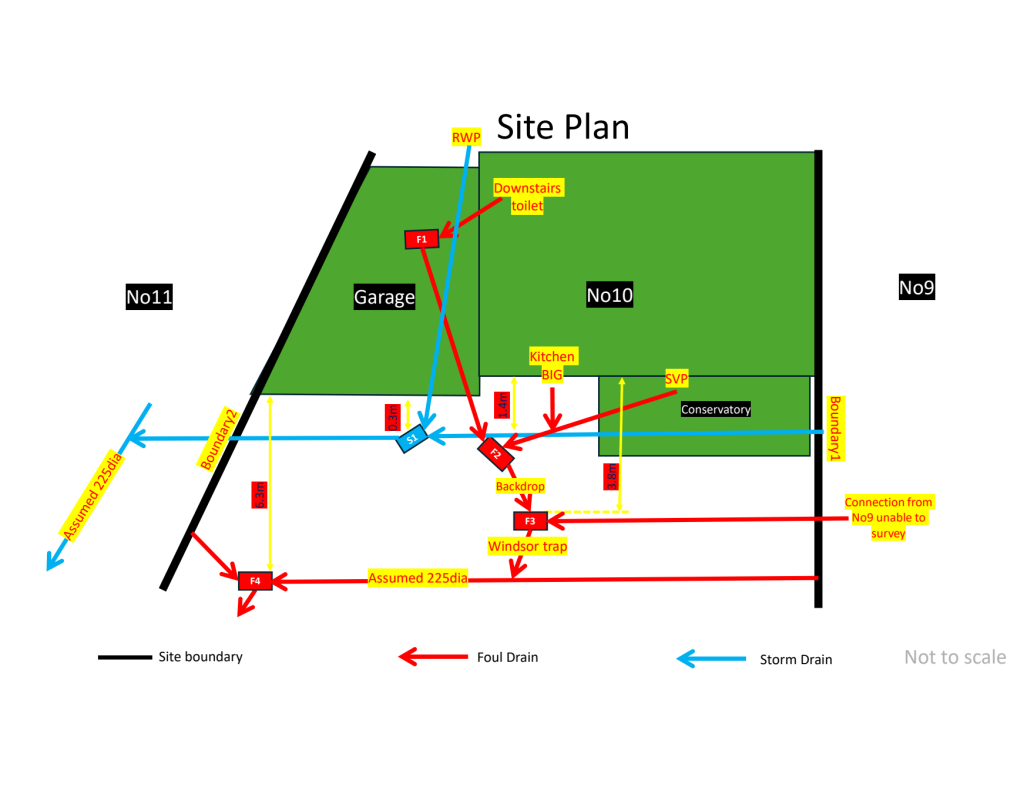
What Severn Trent will want to know
Whether the route is a self-certification for a straightforward case or a formal agreement for anything more involved, the questions are the same:
- Where the pipe runs, accurately, relative to the proposed structure.
- How deep it is, and how deep the foundations will be.
- What condition it is in, because nobody wants to adopt responsibility for a defective pipe that is about to be built on top of.
- Where the chambers are, and whether access will be preserved.
- What it serves: one property or several.
That list is essentially a description of a CCTV survey with a drainage plan. It is why the survey is worth doing at design stage rather than after: the drawings can move a metre far more cheaply than the sewer can.
Manholes are the hard case
You cannot normally build over an inspection chamber or manhole. Access has to be maintained, and a chamber sealed inside a new structure is not access.
The options are to redesign around it, to relocate the chamber, or to divert the run entirely. All three are easier to price when you know exactly where the chamber is, what depth it is at, and what connects into it. In several of the properties we have surveyed, chambers had been buried by previous landscaping, our reports record those explicitly, because a chamber nobody knows about is the one that stops a build.
Section 185: moving the sewer
Where a public sewer genuinely sits where you need to build, Section 185 of the Water Industry Act 1991 gives you a route. It lets you require the sewerage undertaker to divert the sewer, and obliges them to do it where it is reasonably practicable to do so.
The essentials:
- You apply, they design and carry out the work. It is their asset.
- You pay. The requisitioner bears the reasonable cost of the diversion.
- It is not quick. Design, approval and programming take time, and that time belongs on your build programme rather than at the end of it.
- Reasonably practicable does the work in that sentence. A diversion that cannot maintain flows or that has nowhere to go may not be possible, and then the answer is to change the design.
A survey does not get you a diversion. What it gives you is the evidence to have the conversation (position, depth, direction of flow, connections, condition) and a realistic idea of whether a diversion or a redesign is the cheaper path.
Doing it in the right order
- Survey and map the drainage before the design is fixed.
- Establish what is public and what is private from the layout and the connections.
- Design around what is there if you can. Moving a wall is cheaper than moving a sewer.
- Apply for build over or diversion with the survey and plan attached.
- Keep the recording. It is evidence of the condition the pipe was in before your works began, which is worth having if anyone later suggests the build damaged it.
That last point is worth more than it sounds. Once you have built over a pipe, any future defect in it is going to be discussed in terms of whether your works caused it. A dated, coded, graded record of its condition beforehand ends that argument.
What we do and what we do not
We survey, code and map. We produce the plan and the graded report that goes with the application, and we can do it beyond our usual unblocking area.
We do not carry out diversions, repairs or excavation, and we do not submit the application for you. That work belongs to a drainage contractor and to Severn Trent. It also means we have no interest in the answer being complicated.
Related: Build over surveys · Drain mapping and site plans · Drainage advice
More guides: How to tell pitch fibre from clay, and why it matters · Roots, joints and why old clay fails · What a homebuyer drain survey actually finds
Talk to the person who will do the work.
Surveys across the West Midlands, south Staffordshire, east Shropshire and north Worcestershire. Unblocking closer to home.