
We survey across DY10 and DY11 from our base in Castlecroft, Wolverhampton. Every section graded, every defect coded to MSCC, a site plan, the full video — and the report back the same day, by NADC-certified surveyors.
Call 0800 772 33 99 · Request a survey · What a survey covers
Why drains fail in Kidderminster
What is under the ground matters more than the age of the house. These are the conditions behind most of what we find here.
A carpet town, and the mills came with their own drainage. Kidderminster’s carpet industry ran on water from the Stour, and the industrial drainage laid to serve the mills – larger bore, heavier duty, frequently altered – underlies a good deal of what is now housing. Almost none of it matches a surviving drawing.
Sandstone, and what it does to a small defect. The town sits on Triassic sandstone, which drains freely. Soakaways work well here; open joints do not, because fine material migrates out over the years and leaves a void for the pipe to settle into. A minor defect on this ground deteriorates faster than the same defect on clay.
None of that is visible from the surface, which is why a camera settles in an hour what guesswork will not settle at all.
Why people here ask for one
Most often it is buying a property, or an insurance claim. All the reasons a survey gets commissioned
Areas we cover
Blakebrook, Broadwaters, Comberton, Foley Park, Franche, Habberley, Kidderminster town centre, Spennells and Wribbenhall — DY10 and DY11.
Kidderminster sits inside our survey radius but outside our drain unblocking radius, so we cover it for planned survey work rather than emergency call-outs.
A question we get asked here
Our drains were fine at the last survey five years ago. On sandstone that is not as reassuring as it sounds. A joint that was open but stable can wash out a void beneath it in that time.
What a survey tells a buyer that the building survey does not
In Kidderminster – DY10 and DY11 – this is one of the questions we are asked most, and the answer is usually the same across Blakebrook and Broadwaters.
RICS home surveys come at three levels and none of them cameras the drains. A mortgage valuation certainly does not.
What the camera adds is the material, the condition, the layout and the ownership picture – four things that between them decide whether a drainage problem on a Kidderminster property is a morning’s work or a serious bill.
Timing matters. Before exchange you have the information and the leverage. After exchange you have only the information.
The report, and what is in it
Kidderminster is consistent enough, from Blakebrook and Broadwaters outwards, to describe in one go. DY10 and DY11 are the area meant.
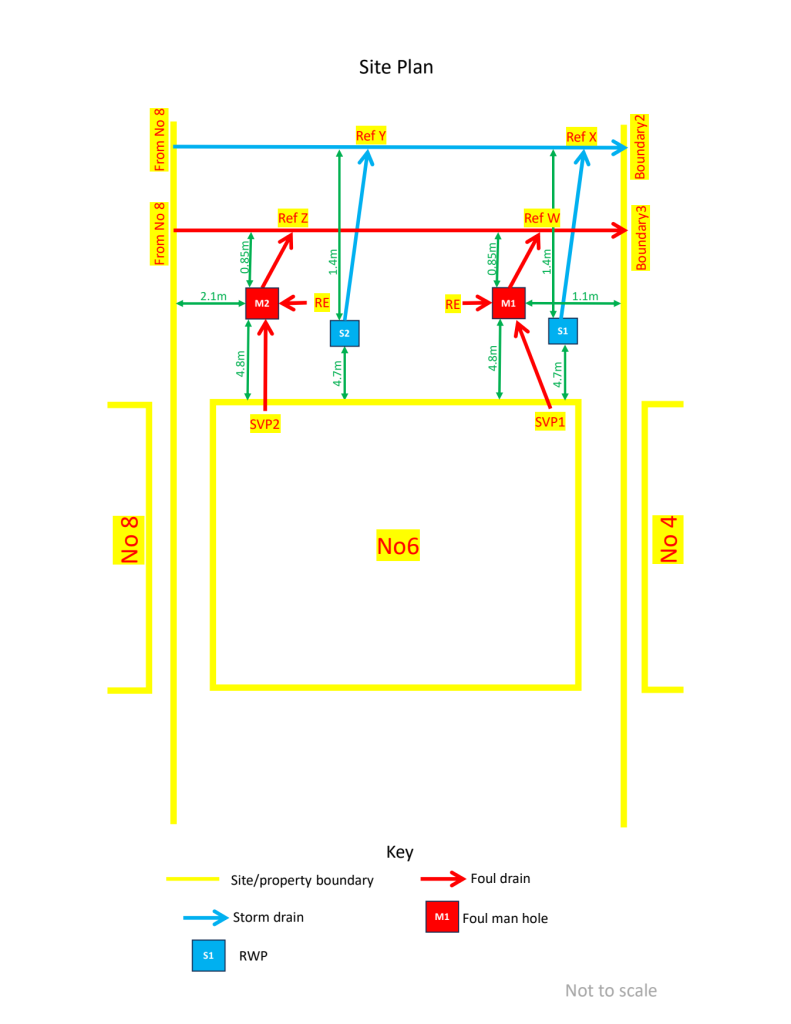
Written to be handed to somebody else – a solicitor, an insurer, a water authority – rather than just read once.
Each section carries a DRB grade and each observation a position in metres and a still image. Our reporting software is WRc-approved and MSCC-compliant, which matters when the report has to satisfy a third party rather than only you.
What it does not contain is a recommendations section quoting for work. We do not carry out repairs, relining or excavation, so we have nothing to sell on the back of what the camera finds. The report sets out what is there and how bad it is; what to do about it is for you and whoever does the work.
Tree roots and Kidderminster drainage
Around Blakebrook, Broadwaters, Comberton the housing is old enough for this to matter, and DY10 and DY11 is where we see it most.
Roots do not break into a sound pipe. The guide printed in the back of our own survey reports puts it plainly: roots normally infiltrate via bad joints, cracks, fractures and breaks. The defect comes first and the root exploits it.
What a root is looking for is water, and a drain leaking at a joint into dry summer soil is an obvious source. A hair root finds the gap, and once inside – in a constant supply of exactly what it wants – it thickens. The root that got in through a two millimetre gap becomes a twenty millimetre root and levers the joint further apart.
Inside the pipe it behaves like a net. Water passes through it. Paper, fat and solids do not. From the house everything seems fine until the day it is not.
What the drains under Kidderminster are made of
Blakebrook and Broadwaters are a fair sample of Kidderminster drainage, and what follows is what we find across DY10 and DY11.
It matters more than people expect, because the material decides how a drain fails and what putting it right involves.
Vitrified clay. What most pre-1970s drainage here is built from. Durable and chemically inert, but laid in short lengths, so a thirty metre run has twenty or thirty joints – and joints are where ground movement shows up. Across the surveys we have written up, displaced joints account for 35 of the 60 defects recorded.
Pitch fibre. Used from roughly the 1940s to the 1970s. It deforms rather than cracks, going oval under load, so blockages become gradually more frequent rather than arriving suddenly.
Plastic – PVC, polypropylene, polyethylene. Later work and newer estates. Fewer joints, but it can still be crushed, and it settles like anything else.
Recently built property in Kidderminster
Kidderminster covers a fair spread of housing, from Blakebrook, Broadwaters, Comberton, and this applies to most of it.
We survey a good deal of newer housing, and the reason is usually a warranty deadline rather than a blockage.
Drainage laid during construction is not always laid correctly, and the problems tend to surface once the ground has settled – by which time the question is whether it is still covered. A graded report with each observation positioned in metres is what makes that conversation possible.
Extending a property in Kidderminster
Kidderminster covers a fair spread of housing, from Blakebrook, Broadwaters, Comberton, and this applies to most of it.
The expensive version of this always runs the same way: plans drawn, quotes accepted, foundations marked out, and then somebody lifts a cover in the middle of where the extension is going.
If you intend to build over a public sewer or lateral drain, or within three metres of one, you need Severn Trent’s agreement. Two things catch people out after the 2011 transfer: the pipe down your own garden may be a public sewer if it serves more than one property, and the length beyond your boundary transferred as well.
They will want to know where the pipe runs, how deep it is, what condition it is in and where the chambers are. That list is a description of a survey with a drainage plan, which is why it is worth doing at design stage rather than after.
Nearby: Stourport-on-Severn · Stourbridge · Bromsgrove Coverage: Areas we cover across Worcestershire
Talk to the person who will do the work.
Surveys across the West Midlands, south Staffordshire, east Shropshire and north Worcestershire. Unblocking closer to home.