
We survey across ST16 to ST18 from our base in Castlecroft, Wolverhampton. Every section graded, every defect coded to MSCC, a site plan, the full video — and the report back the same day, by NADC-certified surveyors.
Call 0800 772 33 99 · Request a survey · What a survey covers
Why drains fail in Stafford
Most recurring problems here trace back to ground conditions rather than to anything that was put down the drain. This is why.
A town built beside a river that regularly reminds it. Stafford sits low against the Sow, and the flat ground around Doxey and Castletown drains slowly with a high water table beneath it. Where groundwater is high, infiltration through an open joint is a real finding rather than a theoretical one – and it loads a system that has little spare capacity when it rains. What that causes: a partly blocked run that copes in dry weather and surcharges in the first real downpour.
A medieval core and a great deal of later expansion. The town centre carries drainage of every era, much of it unrecorded and repeatedly altered; the post-war estates at Highfields and Wildwood bring pitch fibre, the 1950s-70s pipe that deforms rather than cracks.
Which is why we would rather put a camera down the run than tell you what is probably wrong with it.
Why people here ask for one
Most often it is an insurance claim, or a drain that keeps blocking. All the reasons a survey gets commissioned
Areas we cover
Baswich, Castletown, Doxey, Highfields, Rickerscote, Stafford town centre, Weeping Cross and Wildwood — ST16 to ST18.
Stafford sits inside our survey radius but outside our drain unblocking radius, so we cover it for planned survey work rather than emergency call-outs.
A question we get asked here
Water is getting into our drains rather than out — is that a problem? Yes. Infiltration means there is an opening, and on the Sow floodplain there is always groundwater available to exploit it.
If it keeps blocking in Stafford
What holds for Baswich and Castletown holds across the rest of Stafford. ST16 and ST18 are the postcode districts involved.
A drain that has blocked twice in a season is telling you something structural, and clearing it a third time treats the symptom.
Rodding punches a hole through. Flow returns and the water goes away, but a 100 mm pipe with a 30 mm channel rodded through it is carrying a fraction of its capacity, with the rest of the obstruction still sitting there.
Jetting works on the whole bore. The nozzle scours the pipe wall as it is drawn back, follows bends that rods will not, and takes the run back towards its actual diameter.
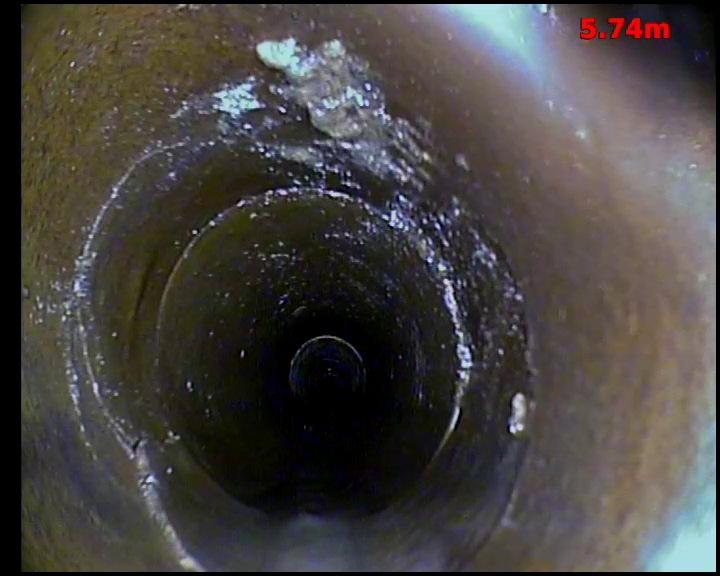
Then put a camera down the same run. Standing water hides everything, so the survey is worth doing once the pipe is clear – which is why we do both in one visit.
Pipe material, and why we record it
It varies street by street in Stafford, but ST16 and ST18 follows a recognisable pattern and Baswich and Castletown are typical of it.
Every section in our reports names the material, because it is the first thing any repair quote will turn on.
Vitrified clay dominates older Stafford drainage. Short lengths, many joints, and the joints are the weak point rather than the pipe.
Pitch fibre appears on post-war estates. It deforms along its length instead of cracking at a point, so it is a whole-run problem when it goes.
Modern plastics are on newer work. Better in most respects, but not immune – they crush under load and settle in made ground like anything else.
What a survey tells a buyer that the building survey does not
We cover ST16 and ST18, and this comes up often enough on Stafford property to be worth setting out properly. Baswich and Castletown see it as much as anywhere.
RICS home surveys come at three levels and none of them cameras the drains. A mortgage valuation certainly does not.
What the camera adds is the material, the condition, the layout and the ownership picture – four things that between them decide whether a drainage problem on a Stafford property is a morning’s work or a serious bill.
Timing matters. Before exchange you have the information and the leverage. After exchange you have only the information.
What we need on site in Stafford
Baswich and Castletown are a fair sample of Stafford drainage, and what follows is what we find across ST16 and ST18.
A few practical things that make the difference between an hour and half a day.
Somewhere to park within reach of the run. The hose and the camera reel both have a working length.
An accessible chamber. Buried or paved-over covers are common on older Stafford property and finding one is part of the job, but knowing where it is saves time.
Water and power are not needed – the van carries both.
Clear the area if you can. Bins, planters and parked cars over the covers are the usual delay.
Commercial and landlord work around Stafford
We cover ST16 and ST18, and this comes up often enough on Stafford property to be worth setting out properly. Baswich and Castletown see it as much as anywhere.
The report matters more on commercial work than domestic, because somebody else usually has to be satisfied by it – a landlord, a managing agent, an insurer or an incoming tenant.
Every section graded, every defect coded to MSCC and positioned in metres, a plan of the system and the full recording. That is a document you can hand over rather than a verbal account of what somebody saw.
Planned rather than reactive is the cheaper pattern on a Stafford commercial site: a survey before a lease event, a jetting visit before the season that always causes trouble, rather than an emergency at the worst moment.
Nearby: Cannock · Penkridge · Rugeley Coverage: Areas we cover across Staffordshire
Talk to the person who will do the work.
Surveys across the West Midlands, south Staffordshire, east Shropshire and north Worcestershire. Unblocking closer to home.