
0800 772 33 99 — we cover DY3 from our base in Castlecroft, Wolverhampton.
Two things, both from the same van: clearing a drain that has blocked, and putting a camera down one to find out why.
Call now · Request a call back
What we do in Sedgley
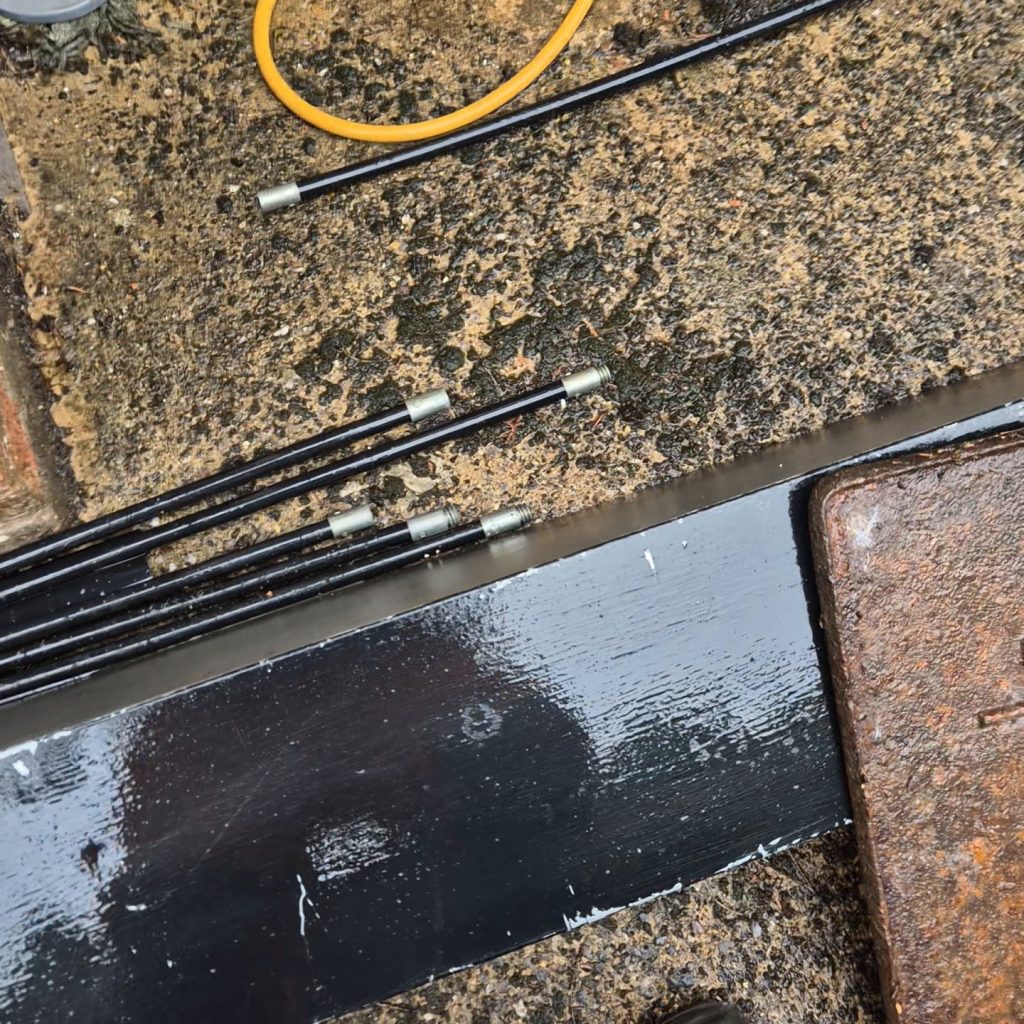
Blocked drains — cleared with high-pressure jetting rather than rods. Drain unblocking
CCTV drain surveys — graded, MSCC-coded, site plan and full video, report back the same day by NADC-certified surveyors. CCTV drain surveys
No repairs, no excavation — so no reason to find work that isn’t there.
Why people here ask for a survey
Building over or near a drain. Extensions, conservatories and garden rooms frequently sit over a shared lateral or a public sewer. Severn Trent will want the position, depth and condition of the pipe before agreeing a build-over.
An insurance claim. Escape of water and subsidence claims turn on evidence. A graded, coded report by a certified surveyor is what an insurer will accept.
All the reasons a CCTV survey gets commissioned
Why drains fail in Sedgley
What is under the ground matters more than the age of the house. These are the conditions behind most of what we find here.
The town sits on a limestone ridge. Sedgley Beacon is one of the highest points in the Black Country, and the limestone beneath it was quarried and mined for centuries. Ground worked that heavily settles unevenly, and drainage laid across it ends up with stepped joints.
Steep falls, then flat ones. Runs coming off the ridge scour themselves clean; the flatter sections they discharge into do not. Deposits accumulate right where the gradient changes, which is usually some distance from the property that notices the problem.
Coal on the eastern side. Towards Woodsetton and Gornal the Thick Coal was worked at shallow depth, adding a second source of ground movement. What that causes: ground that keeps moving long after the workings closed, which pulls rigid clay joints out of line and lets roots and silt in.
All of it shows up on camera and none of it shows from a manhole cover, which is the practical reason a survey is worth more here than an opinion.
Who pays
Anything shared or beyond your boundary belongs to Severn Trent, and with Sedgley’s falls the blockage is frequently downhill of – and nothing to do with – the house that reported it.
Areas we cover
Cotwall End, Gornal Wood, Lower Gornal, Sedgley, Upper Gornal and Woodsetton — DY3.
Commercial drainage in Sedgley
Sedgley covers a fair spread of housing, from Cotwall End, Gornal Wood, Lower Gornal, and this applies to most of it.
Pubs, takeaways, care homes, schools and industrial units all have the same problem in different proportions: more volume, more grease, and far more cost attached to being shut.
Grease is the recurring one. Any kitchen produces it, and where an interceptor is undersized or unmaintained the run downstream of it silts progressively until it stops.
Wipes in a care or nursing setting behave exactly as they do domestically, but at volume.
Yard and forecourt gullies collect silt, leaves and whatever the site does.
We survey and we clear. We produce the graded, coded report a landlord, insurer or managing agent will want, and we do not quote for repairs, so there is no incentive in what the camera finds.
Roots in the drain: what is actually happening
It varies street by street in Sedgley, but DY3 follows a recognisable pattern and Cotwall End and Gornal Wood are typical of it.
Root ingress accounts for 8 of the 60 defects in our reports – less common than displaced joints, but almost always found alongside them, which is the point.
Mature planting near a run is the usual setting. The mechanism is always the same: a joint opens, water escapes, roots follow the moisture in, and then thicken until they are holding the joint open themselves.
On camera it is unmistakable – fine white or brown fibres trailing in the flow, or a dense mass filling part of the bore, nearly always at a joint you can see behind it.
Clearing it restores flow. It does not close the joint, which is why it comes back.
Recurring blockages: the cheaper order of operations
We cover DY3, and this comes up often enough on Sedgley property to be worth setting out properly. Cotwall End and Gornal Wood see it as much as anywhere.
Clearing the same Sedgley drain every few months costs more over a year than finding out why once.
Repeat blockages in one spot almost always have a physical cause. A displaced joint leaves a step for solids to catch on. A length that has lost its fall holds water, and solids drop out of suspension in the flat. A crushed section under a drive does the same.
So: jet it properly rather than rod it, put the camera down while the bore is clear, and get the defect positioned in metres and coded. “There is a problem out the back” is not something anyone can quote against. “Joint displaced medium at 14.2 m, severity 3” is.
The report, and what is in it
Sedgley covers a fair spread of housing, from Cotwall End, Gornal Wood, Lower Gornal, and this applies to most of it.
Written to be handed to somebody else – a solicitor, an insurer, a water authority – rather than just read once.
Each section carries a DRB grade and each observation a position in metres and a still image. Our reporting software is WRc-approved and MSCC-compliant, which matters when the report has to satisfy a third party rather than only you.
What it does not contain is a recommendations section quoting for work. We do not carry out repairs, relining or excavation, so we have nothing to sell on the back of what the camera finds. The report sets out what is there and how bad it is; what to do about it is for you and whoever does the work.
Build over agreements around Sedgley
In Sedgley – DY3 – this is one of the questions we are asked most, and the answer is usually the same across Cotwall End and Gornal Wood.
A survey before the drawings are finished is considerably cheaper than a diversion after them.
You cannot normally build over an inspection chamber – access has to be maintained. The options are to redesign around it, relocate it, or divert the run under Section 185 of the Water Industry Act 1991, which obliges the undertaker to divert a sewer where it is reasonably practicable, at the applicant’s cost.
In several of the properties we have surveyed, chambers had been buried by previous landscaping. A chamber nobody knows about is the one that stops a build, so the survey records them explicitly.
We do not carry out diversions or excavation. We produce the plan and the graded report that goes with the application.
Common questions
The blockage keeps coming back in the same place — why there? Usually because that is where the gradient flattens. Deposits settle at the change of fall, not where the problem starts.
Nearby: Dudley · Wombourne · Bilston Coverage: Areas we cover across the West Midlands
Talk to the person who will do the work.
Surveys across the West Midlands, south Staffordshire, east Shropshire and north Worcestershire. Unblocking closer to home.