
Most people buying a house assume the survey they paid for covered the drains. It almost certainly did not. Below-ground drainage is outside the scope of a standard home survey, and the gap is not a small one.
Call 01902 475 611 · Book a pre-purchase survey
What your survey does and does not include
RICS home surveys come at three levels. A Level 1 is a condition report: a visual inspection of what can be seen. A Level 2, the one most buyers pay for, adds more detail and some advice. A Level 3 building survey is the most thorough of the three.
None of them puts a camera down the drain. At best a surveyor will lift an accessible inspection chamber cover and comment on what is visible from the surface, standing water, a cracked benching, root growth in the chamber. That is a glimpse of one point on a system that may run thirty metres.
A mortgage valuation is not a survey at all. It tells the lender whether the property is worth the money, and it will not touch the drainage.
Why the gap matters more than it sounds
Drainage has an unusual combination of properties. It is invisible from the surface. It is expensive to put right if the problem is structural. It is not something you can negotiate about after completion. And its condition is genuinely unpredictable from the age or the price of the house.
The other thing is that drainage problems do not announce themselves. A pipe can be badly displaced, admitting roots and silting up, and still function well enough that nobody in the house notices until a wet autumn.
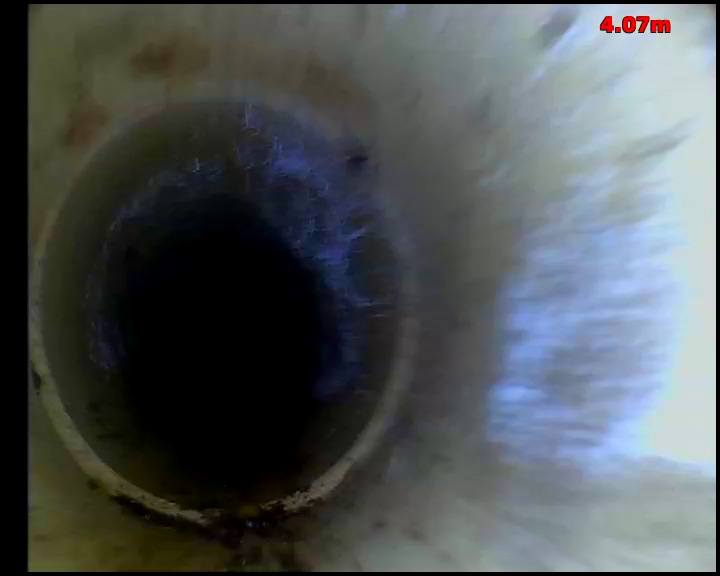
What we actually find
Rather than describe this in the abstract, here is what our own reports contain across the properties we have surveyed and written up.
Most sections are fine. Of the pipe runs graded in those surveys, the majority came back at the top grade with nothing structurally wrong. About a quarter carried defects worth recording, and a smaller number were graded worse than that. A clean report is a common and perfectly useful outcome.
When there is a defect, it is usually a joint. Displaced joints account for 35 of the 60 defects recorded. Cracking accounts for 12. Root ingress for 8. Holes, infiltration and lining defects make up the remainder.
The material is usually clay. 31 of the runs are vitrified clay, which is what most pre-1970s drainage in this region is built from, durable, but laid in short lengths, so there are many joints, and joints are where things move.
Systems are more tangled than people expect. The reports record junctions, connections added after original construction, changes of pipe material partway along a run, and chambers that had been buried. Several properties turned out to have drainage running somewhere nobody had it marked.
What you get, and what it is for
A pre-purchase survey should leave you with four things:
- A recording of every accessible run, so you can see the pipe rather than take our word for it.
- Every defect coded to MSCC: the Manual of Sewer Condition Classification, 5th Edition, published by WRc. This is the industry standard, and it means a defect is described the same way by any competent surveyor. “Joint displaced medium”, for example, has a precise definition: the pipe has moved at the joint by between one and one and a half times the wall thickness.
- A grade for each section, so you can tell an observation from a problem.
- A plan of where the drainage actually runs, which matters if you have any intention of extending.
The report is written to be handed to a solicitor or used in a renegotiation. That is usually its practical value: not the drama of a collapsed pipe, but a documented basis for a conversation about price.
When to book it
Before exchange, and ideally alongside your building survey. After exchange you have the information but none of the leverage.
Our surveys run beyond the area we cover for unblocking, so distance is rarely the constraint. If the drains are blocked when we arrive we would clear them first, the camera cannot see through standing water, and do both in the same visit.
Is it worth it if the house is new?
Newer than 2011 and the pipes are probably not your responsibility past the boundary anyway, see who owns your drain. But new build is not automatically well laid. Drainage is installed early in a build, gets driven over by everything that follows, and settles for years afterwards. Warranty periods are finite, and a survey inside that window is worth more than one outside it.
Related: Homebuyer drain surveys · Case studies · What the grades mean
More guides: Why a rodded drain blocks again in three weeks
Talk to the person who will do the work.
Surveys across the West Midlands, south Staffordshire, east Shropshire and north Worcestershire. Unblocking closer to home.