
A drain survey report is mostly a list of codes and a set of grades, and the natural question is whether the thing you have just been handed is bad news. Usually it is less alarming than it looks, but you have to be able to read it.
Call 01902 475 611 · Book a CCTV survey
Sections, not systems
The first thing to understand is that a survey does not grade “your drains”. It grades each section separately: one run of pipe between two access points, a chamber to a chamber, a rodding eye to a boundary.
A property typically has several. One being graded worse than the others tells you where to look, and it does not mean the whole system is in that condition. In our own reports the properties surveyed have anything from a single section to thirteen.
Two different things are being recorded
Reports confuse people because they mix two kinds of entry, and only one of them is a problem.
Observations describe what is there. A junction, a chamber, a rodding eye, a change of pipe material, the water level, a bend. These are the majority of the entries in most reports, in our surveys, routine observations outnumber defects by roughly three to one. They are how the report describes the shape of your system, and they are not faults.
Defects describe something wrong. These are the ones that carry a severity and drive the grade.
If your report looks alarmingly long, this is usually why. A tidy system with nothing wrong still generates a page of observations.
The codes, and what they actually mean
Defects are coded to the Manual of Sewer Condition Classification, 5th Edition. MSCC5, published by WRc. The value of a standard is that a defect means the same thing whoever recorded it. The definitions below are the ones printed in the back of our own reports.
| Code | Name | What it means |
|---|---|---|
| JDM | Joint displaced medium | The pipe has moved at the joint, across the axis of the pipe. Between 1 and 1.5 times the pipe wall thickness is visible. |
| JDL | Joint displaced large | The same, but more than 1.5 times the wall thickness is visible. |
| R | Roots | Evidence of root ingress. Roots normally get in via bad joints, cracks, fractures or breaks. |
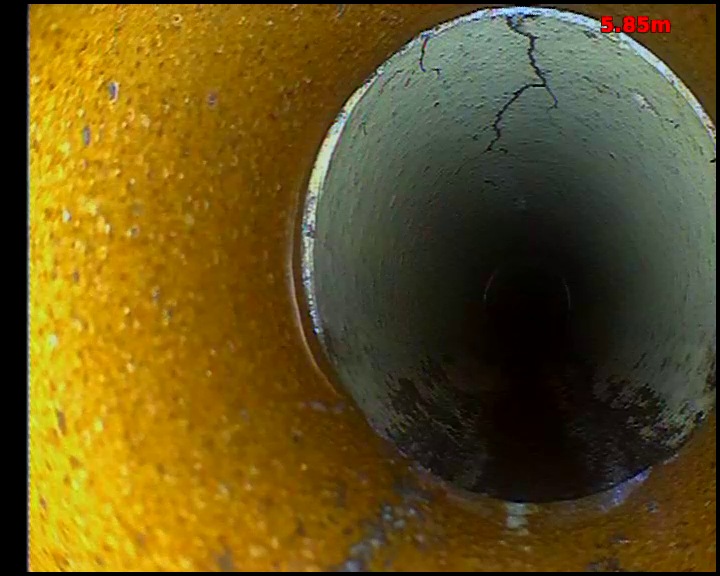
| CC, CL, CR | Cracks | Break lines that are not visibly open. Recorded by clock position. |
| H | Hole | A section of the pipe fabric is missing. |
| I | Infiltration | Water getting in, normally through a joint. |
| LX | Lining defect | A fault in an existing liner. |
Two things worth drawing out. A crack is not an open joint: a crack is a break line that has not opened up, which is why it usually sits at a low severity. And the joint codes are measured against the wall thickness of your pipe, so “medium” and “large” are proportional, not absolute.
Each defect also carries a severity number. A circumferential crack might be recorded at severity 1; a hole in the pipe fabric at severity 4. It is the severity, not the presence of a code, that matters.
The grade
Each section then gets a single letter: the DRB grade, after the Drain Repair Book, the WRc publication the drainage industry uses for repair guidance. It condenses everything found in that section into one character, so you can scan a report and see which run to worry about.
Grades run best to worst. Across all the sections we have surveyed and written up, the distribution looks like this:
| Grade | Sections | Share |
|---|---|---|
| A | 39 | 66% |
| B | 14 | 24% |
| C | 6 | 10% |
That is the honest shape of it: two thirds of the pipe we survey is at the top grade, and we have not yet recorded anything worse than C. A grade C section is not a collapsed drain. It is a section with defects significant enough that you should know about them and plan around them.
Reading your own report in five minutes
- Find the section list and note the grade against each. Ignore the good ones.
- On the worst section, find the defect entries: the ones with a severity.
- Check the position in metres. A defect at 0.5 m is under your garden; at 22 m it may not be your pipe at all.
- Look at the still images. Every observation in our reports carries one.
- Ask what changes it. Some defects need work. Some need watching. Some need nothing but a note in the file for when you sell.
Why we are a reasonable judge of this
We do not carry out repairs, lining or excavation. There is no version of a report where a worse grade earns us more work, which is the main reason we are comfortable publishing the fact that most of what we survey comes back clean.
If yours does not, the next question is usually whose pipe it is,who owns your drain, and, if the defects are at joints, why old clay fails there.
Related: CCTV drain surveys · Case studies · Drainage advice
More guides: Why a rodded drain blocks again in three weeks · Build over agreements and Section 185 diversions
Talk to the person who will do the work.
Surveys across the West Midlands, south Staffordshire, east Shropshire and north Worcestershire. Unblocking closer to home.