
Across every survey we have written up, one defect outnumbers everything else combined. Not collapses, not cracks, not roots. Displaced joints: 35 of the 60 defects we have recorded. Understanding why tells you most of what there is to know about drainage in this part of the country.
Call 01902 475 611 · Book a CCTV survey
What is under most houses here
Vitrified clay is what the majority of pre-1970s drainage in the Midlands is built from, and it is what we find. Of the pipe runs in our reports, 31 are vitrified clay, against 13 polypropylene, 8 polyethylene and a single PVC run. Almost all of it is 100 mm bore; a small number of runs are 150 mm.
Clay is a good material. It is chemically inert, it does not soften, it does not corrode, and pipe laid in the 1930s is often still perfectly serviceable. Its weakness is not the pipe. It is the number of joins.
The arithmetic of joints
Clay is fired in short lengths. A thirty metre run is therefore not one pipe: it is twenty or thirty pipes with a joint between each pair. Older joints were made with sand and cement or a tar-based compound, neither of which stays flexible.
The ground, meanwhile, does not stay still. Clay soil shrinks in dry summers and swells in wet winters. Trees draw moisture out unevenly. Traffic loads the surface. A long run of rigid pipe with rigid joints, laid in ground that moves seasonally, will eventually move at its weakest points, and those are the joints.
Our reports grade that movement precisely, using the MSCC definitions printed in the back of every one:
- Joint displaced medium (JDM): the pipe has moved across its own axis, and between 1 and 1.5 times the pipe wall thickness is visible at the joint. 31 of our recorded defects.
- Joint displaced large (JDL): the same, but more than 1.5 times the wall thickness. 4 of them.
Note that the measure is relative to your pipe’s own wall thickness. That is what makes it comparable between properties and between surveyors.
What a displaced joint does
Three things, in roughly this order.
It creates a step. One pipe edge stands proud of the next. Solids travelling down the pipe catch on it. This is the mechanism behind most repeat blockages that keep recurring in the same spot.
It opens a gap. Where the joint has opened, the pipe is no longer sealed. Water escapes into the ground, and, more of a problem, ground water and fine soil come in. Our reports carry a specific code for that: I, infiltration, water getting in normally via a joint. Silt entering a pipe has to go somewhere, and it settles in the flat spots.
It lets roots in. This is the one people underestimate.
Roots do not break into sound pipe
There is a persistent belief that tree roots crack drains open. They generally do not. The guide in the back of our reports states the mechanism plainly: roots will normally infiltrate via bad joints, cracks, fractures and breaks. The defect comes first; the root exploits it.
What a root is looking for is water and nutrients, and a drain leaking at a joint into dry summer soil is an obvious source. A hair root finds the gap, and once inside, in a constant supply of exactly what it wants, it thickens. It is the thickening that does the damage: the root that entered through a 2 mm gap becomes a 20 mm root and levers the joint further apart.
Inside the pipe, the root mass behaves like a filter or a net. Water passes through it. Paper, fat and solids do not. From the house, everything seems fine right up to the point it does not.
In our surveys, root ingress accounts for 8 of the 60 defects, less common than displaced joints, but almost always found alongside them, which is the point.
What it looks like on camera
- A displaced joint shows as a step or a crescent of shadow where the far pipe no longer lines up with the near one. At severity it is unmistakable.
- An open joint shows a dark band all the way round, sometimes with soil visible behind it.
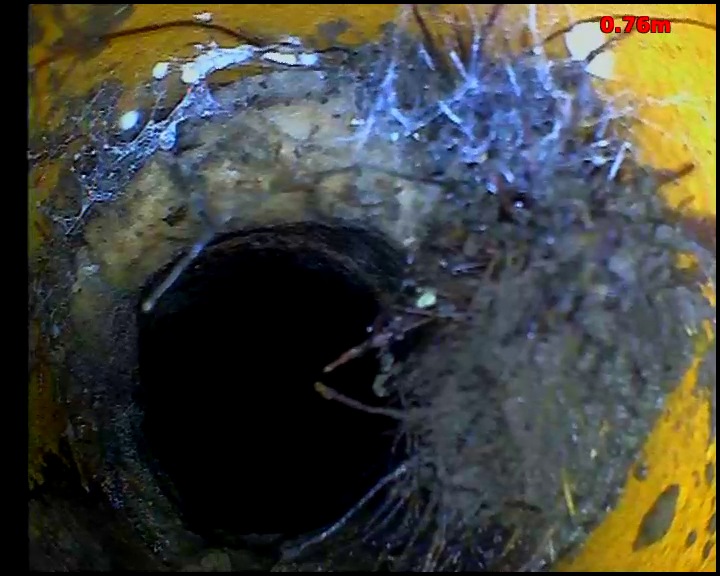
- Roots appear as fine white or brown fibres trailing in the flow, or as a dense mass filling part of the bore. They are nearly always at a joint, and you can usually see the joint they came through.
- Infiltration is visible as running water entering the pipe where no connection exists.
Every observation in our reports carries a still image and a position in metres, so you can see the thing being described rather than take a code on trust.
What follows from it
If your system is clay and something is wrong, the odds are strongly that it is a joint, that it is in one identifiable place, and that it is not a whole-system problem. That is a much better position than it feels like when the drain is backing up.
Three things worth doing in order:
- Clear it properly first. A camera cannot see through standing water, and rods leave most of the obstruction in place, see why a rodded drain blocks again.
- Get the defect positioned and graded, so it can be quoted against and so you can tell an observation from a problem,what the grades mean.
- Check whose pipe it is before paying for anything. Joints fail most often towards the far end of a run, which is frequently past your boundary and therefore Severn Trent’s,who owns your drain.
We survey and we clear. We do not carry out repairs, lining or excavation, so what the camera finds makes no difference to what we earn.
Related: CCTV drain surveys · Case studies · Blocked drains
More guides: What a homebuyer drain survey actually finds
Talk to the person who will do the work.
Surveys across the West Midlands, south Staffordshire, east Shropshire and north Worcestershire. Unblocking closer to home.