
We survey across WS13 and WS14 from our base in Castlecroft, Wolverhampton. Every section graded, every defect coded to MSCC, a site plan, the full video — and the report back the same day, by NADC-certified surveyors.
Call 0800 772 33 99 · Request a survey · What a survey covers
Why drains fail in Lichfield
What is under the ground matters more than the age of the house. These are the conditions behind most of what we find here.
A cathedral city with drainage nobody has ever drawn. Lichfield’s historic core has been continuously occupied for a very long time, and the drainage beneath it has been altered, extended and re-routed by every generation that has lived there. On the older properties the site plan a survey produces is frequently the only accurate record that has ever existed.
Conservation constraints, and what they mean. In the city centre, digging to find out where a pipe goes is the expensive option and sometimes not an option at all. A camera and a sonde answer the same question without lifting anything.
Which is why we would rather put a camera down the run than tell you what is probably wrong with it.
Why people here ask for one
Most often it is no record of where anything runs, or building over or near a drain. All the reasons a survey gets commissioned
Areas we cover
Boley Park, Burntwood, Chasetown, Curborough, Lichfield city centre, Streethay and Whittington — WS13 and WS14.
Lichfield sits inside our survey radius but outside our drain unblocking radius, so we cover it for planned survey work rather than emergency call-outs.
A question we get asked here
Our house is listed — can you still survey the drains? Yes, and it is usually the only sensible way. Nothing is excavated and nothing is disturbed.
Whose drain is it in Lichfield?
Lichfield covers a fair spread of housing, from Boley Park, Burntwood, Chasetown, and this applies to most of it.
Worth settling before money changes hands, because for a good proportion of blockages the answer is Severn Trent and they will attend their own assets at no charge.
Since 1 October 2011, private sewers and lateral drains connected to the public system transferred to the water and sewerage company. The test is two questions: does the pipe still serve only your property, and is it still inside your boundary? If both are yes, it is yours. If either is no – it is shared, or it runs past the boundary – it is very probably theirs.
We will tell you if that is what we find rather than invoicing you for it.
South Staffs Water supplies the drinking water across much of this area but does not handle sewerage. For drainage, Severn Trent is the right number.
Clay, pitch fibre or plastic in Lichfield
Boley Park and Burntwood are a fair sample of Lichfield drainage, and what follows is what we find across WS13 and WS14.
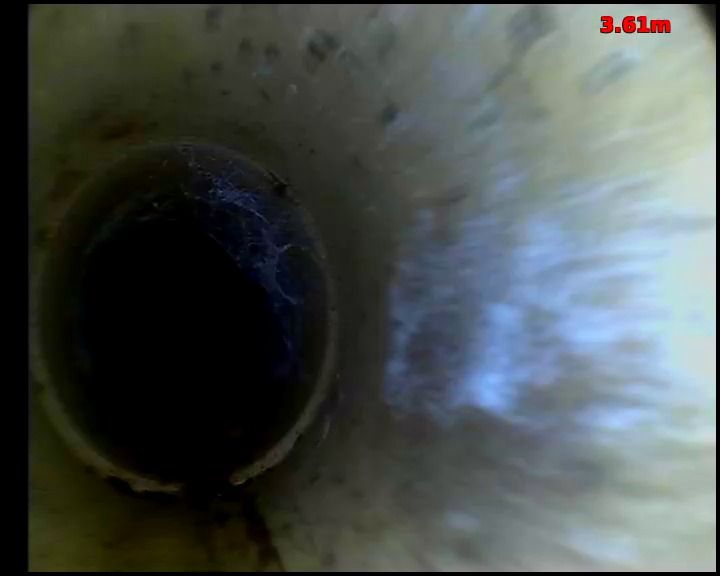
A camera settles what you have in about a minute, and the answer changes what any future work costs.
Clay is the default assumption on older Lichfield property. It is rigid and brittle: it does not rot, but it moves at its joints, and that is where roots get in.
Pitch fibre is the one that catches buyers out. Coal tar impregnated wood fibre, light and quick to lay, and it loses its round shape under load. There is no single joint to point at – the deformation runs for metres.
Plastic turns up on later runs and extensions. It is often spliced into an older clay system partway along, and our reports carry a specific code for exactly that change of material.
Roots in the drain: what is actually happening
On Lichfield property, and particularly around Boley Park, Burntwood, Chasetown, this is the usual picture.
Root ingress accounts for 8 of the 60 defects in our reports – less common than displaced joints, but almost always found alongside them, which is the point.
Mature planting near a run is the usual setting. The mechanism is always the same: a joint opens, water escapes, roots follow the moisture in, and then thicken until they are holding the joint open themselves.
On camera it is unmistakable – fine white or brown fibres trailing in the flow, or a dense mass filling part of the bore, nearly always at a joint you can see behind it.
Clearing it restores flow. It does not close the joint, which is why it comes back.
What we pull out of drains around Lichfield
It varies street by street in Lichfield, but WS13 and WS14 follows a recognisable pattern and Boley Park and Burntwood are typical of it.
The blockage itself is rarely a mystery. It is nearly always one of five things.
Wipes, marketed as flushable. They are not. They keep their structure in water, and they are the first thing we look for.
Sanitary products and nappies. Both swell on contact. Both are common enough that a family home in WS13 and WS14 will meet the problem sooner or later.
Cooking fat. It leaves the sink as liquid and arrives in the drain as a solid. Where a run is shallow or has lost its fall, it builds into a plug.
Root ingress. Mature trees and a joint that has moved are all it takes.
Structural damage. A displaced joint or a crushed section catches solids on every flush, and no amount of clearing fixes that.
Nearby: Burntwood · Tamworth · Cannock Coverage: Areas we cover across Staffordshire
Talk to the person who will do the work.
Surveys across the West Midlands, south Staffordshire, east Shropshire and north Worcestershire. Unblocking closer to home.