
We survey across TF1 to TF7. Telford town centre, Wellington, Oakengates, Dawley, Madeley, Hadley, Ketley, Lawley, Priorslee, Stirchley and Donnington.
A CCTV drain survey puts a camera through your drainage and produces a record of what is actually there: every run, every junction, every defect, positioned to the centimetre and coded to the industry standard.
Call 01902 475 611 · Request a survey
When people call us for one
Buying a house. A homebuyer drain survey is the one part of a purchase most people skip, and in Telford it is worth more than most places, see below.
A drain that keeps blocking. Repeated blockages are a symptom of something structural. A survey finds the cause rather than clearing the effect again.
Building over or near a drain. Extensions and garden rooms frequently sit over a shared lateral. Severn Trent will want position, depth and condition before agreeing a build-over.
New-build and warranty issues. Telford has a great deal of recent housing, and drainage laid during construction is not always laid correctly. A survey settles it while a warranty still applies.
What the survey covers
- Every accessible run, manhole to manhole, plus rodding eyes, gullies and soil vent pipes.
- Defects coded to MSCC, positioned in metres from the start of each run.
- A condition grade per section on the Drain Repair Book scale, A to E.
- A site plan of the system.
- The full video.
Same-day reporting, by certified surveyors
You get the report the same day. Surveys are carried out by NADC-certified surveyors and every report carries the surveyor’s certification number, which is what makes it worth something to a solicitor, an insurer or a water authority.
We do not offer a recommendations section: our reports set out what is there and how bad it is, graded section by section, and leave the remedial decision to you.
Why drains fail in Telford
Most recurring problems here trace back to ground conditions rather than to anything that was put down the drain. This is why.
Telford is unlike anywhere else we cover, for one reason: almost all of it was built at once.
A new town, built through the pitch fibre era. Designated in the 1960s and built out through the 1970s and 80s, Telford’s housing stock is concentrated in exactly the decades when pitch fibre drainage was standard. It is a bitumen-impregnated pipe with roughly a fifty-year design life, and that life is up. Pitch fibre does not crack: it delaminates and goes oval, so the bore closes gradually and nothing shows at the surface until blockages become routine. It is also the one material where jetting can do damage if you do not know what you are looking at. If you are buying in Telford, knowing whether the drainage is pitch fibre or clay is the single most useful thing a survey will tell you. What that causes: it deforms along its length instead of failing at a point, which is why the problem creeps up over years and why patching one spot rarely helps.
Ground that was mined before the town existed. Telford sits on the East Shropshire coalfield, coal, ironstone, fireclay and limestone were all worked here, much of it at shallow depth, long before the new town was laid out. The development corporation carried out extensive mineshaft capping and grouting, but ground movement over historic workings still pulls pipe joints apart.
Later phases are modern PVC. The newer estates, Lawley, Priorslee, Muxton, are plastic, which fails differently: joints pulled at installation, debris left in the pipe by builders, and runs laid with insufficient fall. These are the faults we find on relatively new property, and they are usually someone else’s responsibility to put right.
That is the reason a repeat blockage here is worth looking at properly rather than clearing again: the cause is usually structural and it is usually visible.
Who owns the drain
Since the 2011 private sewer transfer, Severn Trent owns most shared drainage and everything beyond your boundary. You are responsible for the pipework serving only your property. If a survey shows the problem is past that line, it may be Severn Trent’s to fix rather than yours.
Two surveys in Telford
A TF2 property: two runs, both graded A, with two cracks logged. A largely sound system with defects worth knowing about but nothing urgent.
A larger TF2 property in Priorslee,thirteen separate runs surveyed, with a single displaced joint found across the whole system. Worst section graded B. A big modern system in good order, and the report proves it.
Getting to the drain
Most of the variability in a drainage job is access rather than the drain itself.
Older Telford housing tends to mean shared entries, rear yards without vehicle access, and chambers that have been built over or landscaped out of sight. None of it is a problem
- it is simply the difference between a short visit and a longer one, and it is the
part we would rather discuss on the phone than discover on arrival.
Recently built property in Telford
We survey a good deal of newer housing, and the reason is usually a warranty deadline rather than a blockage.
Drainage laid during construction is not always laid correctly, and the problems tend to surface once the ground has settled, by which time the question is whether it is still covered. A graded report with each observation positioned in metres is what makes that conversation possible.
What it costs
You get a price on the phone before we come out, so there are no surprises when we arrive.
We do not carry out repairs, relining or excavation. That is worth knowing when you are comparing quotes, because most firms who survey your drains also quote for fixing them
- and when a survey says a section is failing, they are the ones who benefit. We are
not, which is also why we are comfortable telling you when a survey comes back clean.
If the blockage turns out to be on Severn Trent’s side of the boundary, we will say so rather than invoice you for it.
What the camera actually shows
A survey is not a torch down a hole. The camera is fed the length of the run and every observation is recorded against a distance from the start.
Displaced joints show as a step or a crescent of shadow where the far pipe no longer lines up with the near one.
Open joints show a dark band all the way round, sometimes with soil visible behind.
Roots appear as fine fibres trailing in the flow, or a dense mass filling the bore, nearly always at a joint you can see behind them.
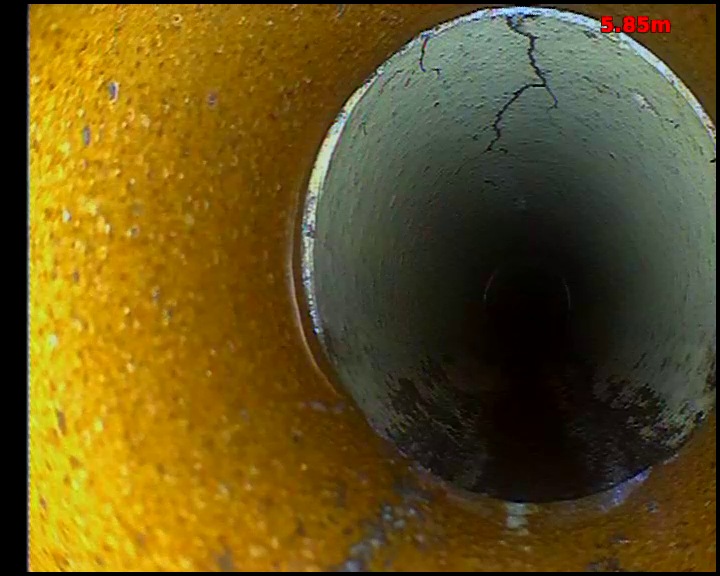
Cracks are break lines that are not visibly open, recorded by clock position.
Infiltration is water entering where no connection exists.
Every one of those carries a still image in the report, so you can see the thing being described rather than take a code on trust.
Common questions
How long does a survey take? One to three hours for most domestic properties, longer for large systems: the Priorslee survey above covered thirteen runs.
Can you tell if my drains are pitch fibre? Yes, and in Telford it is one of the first things we look for. It is visible on camera immediately.
More questions about CCTV drain surveys
Also in Telford: Blocked drains and drain unblocking Nearby: Shifnal · Bridgnorth · Newport · Wolverhampton Coverage: Areas we cover across Shropshire
Case studies: Survey in Telford: cracking and fracturing · Survey in Telford: displaced and open joints
More nearby: Drainage services in Albrighton · Drain unblocking in Wolverhampton · Blocked drains in Bilston · Drain unblocking in Willenhall
Talk to the person who will do the work.
Surveys across the West Midlands, south Staffordshire, east Shropshire and north Worcestershire. Unblocking closer to home.