
We are based in Castlecroft, so Wolverhampton is not a place we travel to: it is where our vans start. Most of the city is inside fifteen minutes of the yard, and we survey across WV1 to WV6, WV10, WV11 and WV14.
A CCTV drain survey puts a camera through your drainage and produces a record of what is actually there: every pipe run, every junction, every defect, positioned to the centimetre and coded to the industry standard. It is the difference between guessing why a drain keeps backing up and knowing.
Call 01902 475 611 · Request a survey
When people call us for one
Buying a house. A homebuyer drain survey is the one part of a property purchase most people skip, and the one that can carry a five-figure bill behind it. A standard structural survey does not go underground. Ours does, and the report is written so you can hand it straight to a solicitor or use it to renegotiate.
A drain that keeps blocking. If the same gully or toilet backs up every few months, something structural is causing it. Clearing it again treats the symptom. A survey finds the root, the displaced joint or the broken section that keeps catching solids.
Building over or near a drain. Extensions, conservatories and garden rooms frequently sit over a public sewer or a shared lateral. Severn Trent will want to know where the pipe runs, its condition and its depth before agreeing a build-over. A survey with a plan is what that conversation needs.
Selling, or settling an argument. Shared drainage between neighbours is a common source of disputes about who pays. A recorded survey moves it from opinion to evidence.
What the survey covers
- Every accessible run, manhole to manhole, plus rodding eyes, gullies and soil vent pipes.
- Defects coded to MSCC, the industry’s Manual of Sewer Condition Classification, with each observation positioned in metres from the start of the run.
- A condition grade per section on the Drain Repair Book scale, A to E, so the urgent and the cosmetic are separated.
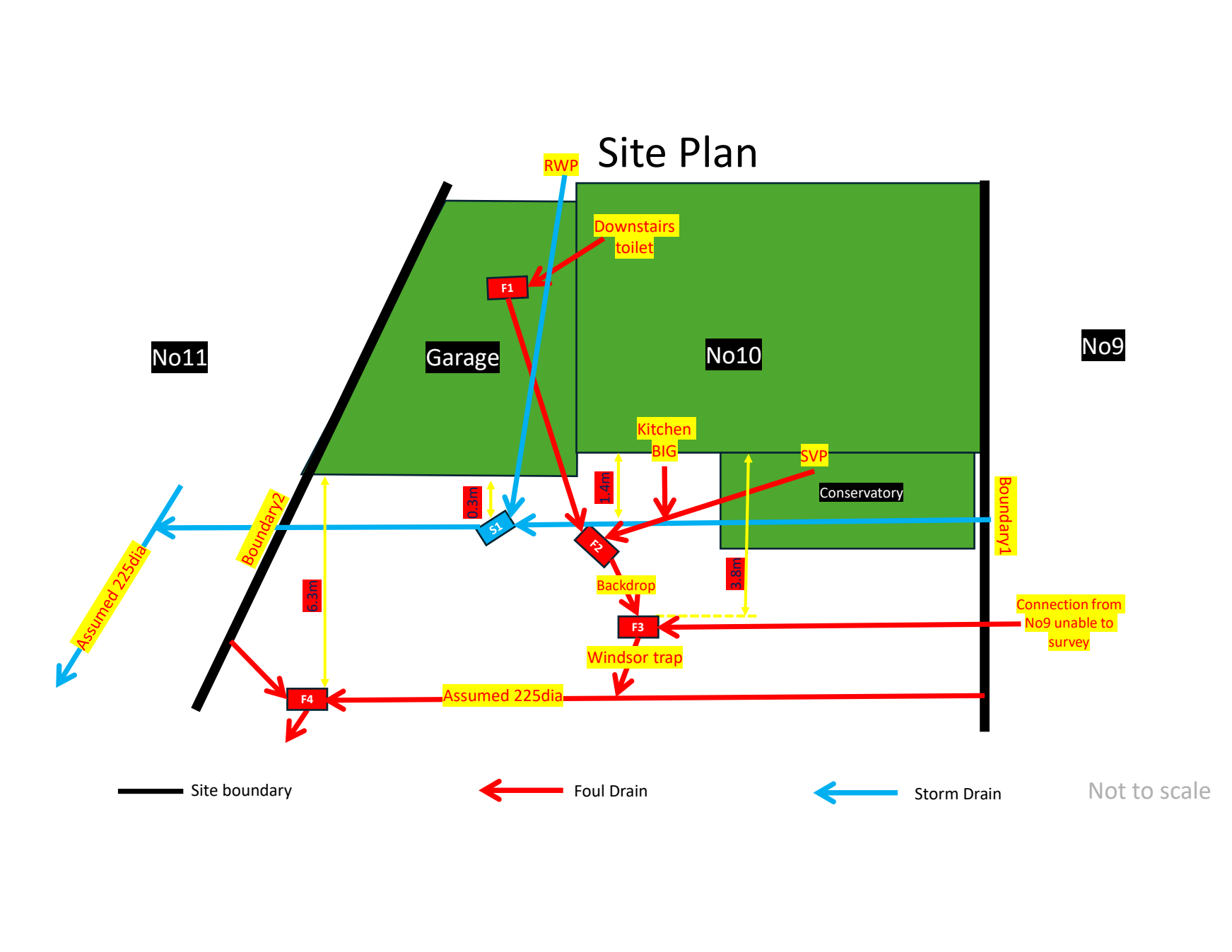
- A site plan showing the layout of the system, which for most properties has never existed before.
- The full video, so you can see the defect rather than take our word for it.
Our reporting software is WRc-approved and MSCC-compliant, which matters when the report has to satisfy a water authority, a solicitor or an insurer rather than just you.
Same-day reporting, by certified surveyors
Two things separate us from most firms who will put a camera down a drain.
You get the report the same day. Not in a week, not “in due course”. If you are mid-purchase with a chain waiting on you, or arguing with a neighbour about a shared run, a report that lands the same evening is worth considerably more than the same report a fortnight later.
The surveys are carried out by NADC-certified surveyors, and every report carries the surveyor’s certification number on it. That is what makes the document worth something to a third party. Plenty of drainage firms will sell you a video file; far fewer will give you a coded, graded, certified report that a solicitor or an insurer will actually accept.
What we do not claim is a recommendations section, our reports set out what is there and how bad it is, graded section by section, and leave the remedial decision to you and whoever you appoint to do the work.
Why drains fail in Wolverhampton
What is under the ground matters more than the age of the house. These are the conditions behind most of what we find here.
Three things about this city shape what we find on camera.
The housing stock splits sharply by era. The Victorian terraces of Whitmore Reans, Dunstall, All Saints and Penn Fields are salt-glazed vitrified clay, durable, but brittle and laid in short lengths, so a single run can have thirty joints. Joints are where almost everything goes wrong. The interwar semis across Penn, Finchfield and Tettenhall are the same material, generally in better condition. The post-war estates around Bushbury, Low Hill, Wednesfield and Bilston are where pitch fibre turns up: a bitumen-impregnated material used through the 1950s to 70s, now well past its design life, which delaminates and goes oval rather than cracking. Pitch fibre is not repairable in place and it does not announce itself from the surface.
The ground moves in the east and south. Wolverhampton sits on the edge of the South Staffordshire coalfield, and shallow historic workings run under Bilston, Bradley and Ettingshall. Ground movement pulls pipe joints apart. Displaced joints are the most common structural defect we log across the city, and they are rarely the householder’s fault.
Sandstone drains well and washes out. Much of Wolverhampton sits on Sherwood Sandstone, which is why soakaways work here when they fail elsewhere. The same permeability means fine material can migrate out through a defective joint over years, leaving a void that lets the pipe drop further. A small defect on sandstone is worth acting on sooner than the same defect on clay. What that causes: water leaving a cracked joint drains away instead of pooling, so there is nothing to see at the surface: the pipe quietly takes in soil until it blocks.
Which is why we would rather put a camera down the run than tell you what is probably wrong with it.
Who actually owns the drain
Since the 2011 private sewer transfer, Severn Trent owns most shared drainage and everything beyond your property boundary. You are responsible for the pipework that serves only your property, up to the boundary. If a survey shows the problem is past that line, it may be Severn Trent’s to fix rather than yours, and that is worth knowing before you pay for anything.
One point that catches people out: South Staffs Water supplies Wolverhampton’s drinking water but is not the sewerage undertaker. For a drainage problem, Severn Trent is who you want.
Two surveys from around the city
A Penn property (WV4), eight separate runs, foul and combined, a mix of clay and later PVC. Fifteen defects logged: six cracks, three points of root ingress, three displaced joints, two failures in an existing lining and one broken section. Worst section graded C.
A Bushbury property (WV10): two runs surveyed across two visits. No structural defects at all. A clean result is a real result: for a buyer, it takes drainage off the list of things to worry about, and the recording proves it.
Read the Wolverhampton case studies
Recently built property in Wolverhampton
We survey a good deal of newer housing, and the reason is usually a warranty deadline rather than a blockage.
Drainage laid during construction is not always laid correctly, and the problems tend to surface once the ground has settled, by which time the question is whether it is still covered. A graded report with each observation positioned in metres is what makes that conversation possible.
Getting to you
We work out of Castlecroft in Wolverhampton, and Wolverhampton is close enough that the constraint on timing is the diary rather than the drive.
Ring and we will give you a straight answer on when, and a price before we set off.
Recurring blockages: the cheaper order of operations
Clearing the same Wolverhampton drain every few months costs more over a year than finding out why once.
Repeat blockages in one spot almost always have a physical cause. A displaced joint leaves a step for solids to catch on. A length that has lost its fall holds water, and solids drop out of suspension in the flat. A crushed section under a drive does the same.
So: jet it properly rather than rod it, put the camera down while the bore is clear, and get the defect positioned in metres and coded. “There is a problem out the back” is not something anyone can quote against. “Joint displaced medium at 14.2 m, severity 3” is.
What the camera actually shows
A survey is not a torch down a hole. The camera is fed the length of the run and every observation is recorded against a distance from the start.
Displaced joints show as a step or a crescent of shadow where the far pipe no longer lines up with the near one.
Open joints show a dark band all the way round, sometimes with soil visible behind.
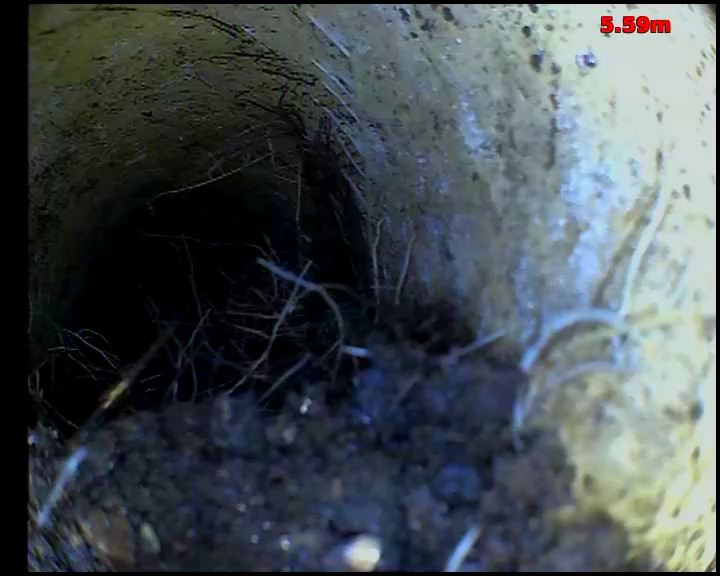
Roots appear as fine fibres trailing in the flow, or a dense mass filling the bore, nearly always at a joint you can see behind them.
Cracks are break lines that are not visibly open, recorded by clock position.
Infiltration is water entering where no connection exists.
Every one of those carries a still image in the report, so you can see the thing being described rather than take a code on trust.
What actually blocks a drain in Wolverhampton
Almost everything we pull out of a domestic drain falls into a short list, and most of it should never have gone down there in the first place.
Wet wipes. The single commonest cause we attend. They do not break up the way paper does, and once one snags on a rough joint the rest build against it until the bore is gone.
Nappies and sanitary items. They are designed to swell. A drain that will pass one will block on the third.
Fat, oil and grease. Poured down warm, set solid cold. On a WV1, WV10 and WV11 run with any flat section it catches everything that follows.
Roots. Not a housekeeping problem: a structural one. Roots get in through a joint that has already opened, and then behave like a net.
A pipe that is already damaged. If a run blocks repeatedly in the same place, the cause is usually the pipe rather than what went into it.
Common questions
How long does a survey take? Most domestic properties take between one and three hours on site, depending on how many runs there are and how accessible the manholes are.
Can you survey if the drain is currently blocked? We would normally clear it first: the camera cannot see through standing water and debris. We can do both in one visit.
More questions about CCTV drain surveys
Also in Wolverhampton: Blocked drains and drain unblocking Nearby: Bilston · Willenhall · Dudley · Walsall Coverage: Areas we cover across the West Midlands
Case studies: Survey in Wolverhampton: a clean system · Survey in Wolverhampton: cracking and fracturing
More nearby: Blocked drains in Bilston · Drain unblocking in Willenhall · Blocked drains in Dudley · Drain unblocking in Walsall
Talk to the person who will do the work.
Surveys across the West Midlands, south Staffordshire, east Shropshire and north Worcestershire. Unblocking closer to home.