
We survey across WS1 to WS5, WS8 and WS9. Walsall town centre, Caldmore, Palfrey, Pleck, Birchills, the Chuckery, Bloxwich, Blakenall, Goscote, Rushall, Pelsall, Brownhills, Aldridge and Streetly.
A CCTV drain survey puts a camera through your drainage and produces a record of what is actually there: every run, every junction, every defect, positioned to the centimetre and coded to the industry standard.
Call 01902 475 611 · Request a survey
When people call us for one
Buying a house. A homebuyer drain survey is the part of a purchase most people skip and the one that can carry the largest unexpected bill. A standard structural survey does not go underground.
A drain that keeps blocking. Repeated blockages mean something structural is causing them. A survey finds the cause.
Building over or near a drain. Extensions and garden rooms frequently sit over a shared lateral or a public sewer. Severn Trent will want position, depth and condition before agreeing a build-over.
Settling a dispute. Shared drainage between neighbours produces arguments about who pays. A recorded, graded survey turns opinion into evidence.
What the survey covers
- Every accessible run, manhole to manhole, plus rodding eyes, gullies and soil vent pipes.
- Defects coded to MSCC, positioned in metres from the start of each run.
- A condition grade per section on the Drain Repair Book scale, A to E.
- A site plan of the system.
- The full video.
Same-day reporting, by certified surveyors
You get the report the same day. Surveys are carried out by NADC-certified surveyors and every report carries the surveyor’s certification number, which is what makes it worth something to a solicitor, an insurer or a water authority.
We do not offer a recommendations section: our reports set out what is there and how bad it is, graded section by section, and leave the remedial decision to you.
Why drains fail in Walsall
What is under the ground matters more than the age of the house. These are the conditions behind most of what we find here.
Two kinds of old workings under the same borough. Walsall sits on the South Staffordshire coalfield, and its limestone was quarried and mined at Hay Head, Daw End and Rushall for lime and ironmaking flux. Both leave the same legacy for drainage: ground that has settled unevenly over a century or more, and pipework laid on the assumption that it wouldn’t. Displaced joints follow, and every displaced joint is a step where solids catch and roots get in.
The housing splits hard by era. The Victorian terraces of Caldmore, Palfrey, Pleck, Birchills and the Chuckery run on salt-glazed vitrified clay in short lengths, thirty joints in a single run is not unusual. The interwar suburbs of Streetly and Aldridge are generally the same material in better condition, but with mature trees over them. The post-war estates, Beechdale, Blakenall Heath, Goscote, parts of Bloxwich, are where pitch fibre appears, a bitumen-based pipe from the 1950s to 70s that goes oval rather than cracking and is now past its design life.
A lot of the borough drains to canal-era levels. Walsall’s drainage was laid around an industrial landscape of canals, cuttings and made ground. Falls are not always what you would expect, and runs sometimes take a route that makes no sense until you see it on camera. What that causes: flat sections where solids settle.
All of it shows up on camera and none of it shows from a manhole cover, which is the practical reason a survey is worth more here than an opinion.
Who owns the drain
Since the 2011 private sewer transfer, Severn Trent owns most shared drainage and everything beyond your boundary. You are responsible for pipework serving only your property. If a survey shows the problem is past that line, it may be Severn Trent’s to fix rather than yours.
Worth knowing: South Staffs Water supplies Walsall’s drinking water but is not the sewerage undertaker. For a drainage problem, Severn Trent is who you want.
A survey in Walsall
A WS5 property, surveyed and graded A, with no structural defects found at all.
That is worth saying plainly, because a clean survey is a real outcome rather than a wasted fee. For a buyer it takes drainage off the list of things to negotiate over, and the recording is there if the question ever comes up again. We are not going to manufacture a problem to justify the visit, and since we do not do repairs or excavation, we have no reason to.
Why it only floods when it rains
Around Aldridge, Beechdale, Birchills the housing is old enough for this to matter, and WS1, WS5 and WS8 is where we see it most.
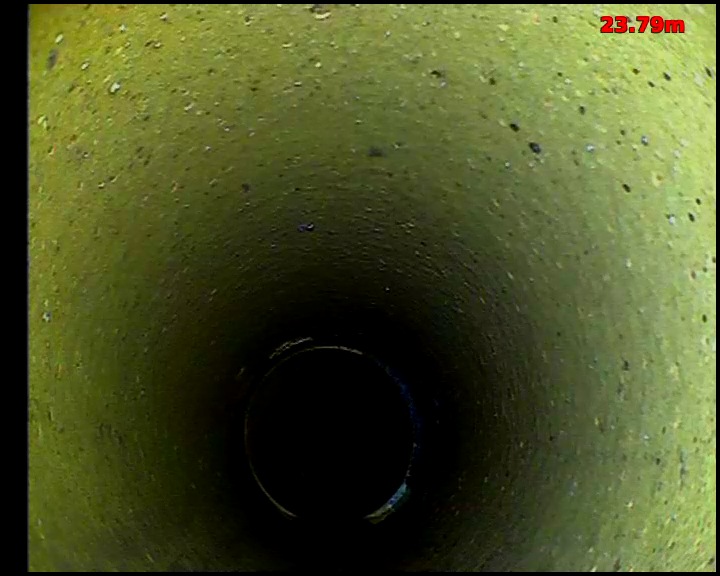
A drain that copes all week and backs up in a downpour is usually telling you about capacity rather than a blockage.
On combined systems, common across older Walsall property, roof and yard water shares the pipe with everything else. Lose part of the bore to silt, roots or a displaced joint and the run still copes with normal flow, until the rain arrives.
Our surveys record water levels at intervals for exactly this reason: a section holding water where it should be running is a finding, not a detail.
Reading a survey of your Walsall drainage
Reports confuse people because they mix two kinds of entry and only one is a problem.
Observations describe what is there: a junction, a chamber, a change of pipe material, the water level. In our surveys these outnumber defects by roughly three to one, and a tidy system with nothing wrong still generates a page of them.
Defects describe something wrong, and carry a severity. It is the severity, not the presence of a code, that matters.
Across every section we have graded, two thirds came back at the top grade. A long report is not automatically bad news.
Commercial drainage in Walsall
Pubs, takeaways, care homes, schools and industrial units all have the same problem in different proportions: more volume, more grease, and far more cost attached to being shut.
Grease is the recurring one. Any kitchen produces it, and where an interceptor is undersized or unmaintained the run downstream of it silts progressively until it stops.
Wipes in a care or nursing setting behave exactly as they do domestically, but at volume.
Yard and forecourt gullies collect silt, leaves and whatever the site does.
We survey and we clear. We produce the graded, coded report a landlord, insurer or managing agent will want, and we do not quote for repairs, so there is no incentive in what the camera finds.
Same drain, same spot, every few months
Walsall is consistent enough, from Aldridge and Beechdale outwards, to describe in one go. WS1, WS5 and WS8 are the area meant.
That pattern is worth taking seriously, because it rarely resolves itself.
The three usual causes are a joint that has moved and now catches everything passing, a section that has settled and no longer falls towards the sewer, or roots holding a joint open. All three are visible on camera and none of them are fixed by clearing.
Worth checking before you pay for anything: repeat blockages near a boundary are very often on the lateral drain, which since 2011 has belonged to Severn Trent rather than you.
Common questions
How long does a survey take? One to three hours for most domestic properties, depending on the number of runs and how accessible the manholes are.
What if the survey finds nothing? Then you have a graded report saying so, and that is the outcome you were hoping for. It is worth having in writing.
More questions about CCTV drain surveys
Also in Walsall: Blocked drains and drain unblocking Nearby: Willenhall · Bloxwich · Aldridge · Wolverhampton Coverage: Areas we cover across the West Midlands
More nearby: Blocked drains in Willenhall · Drain unblocking in Bilston · Blocked drains in West Bromwich · Drain unblocking in Wolverhampton
Talk to the person who will do the work.
Surveys across the West Midlands, south Staffordshire, east Shropshire and north Worcestershire. Unblocking closer to home.