
We are based in Castlecroft, about twenty minutes from Dudley town centre, and we survey across DY1, DY2 and DY3. Dudley, Netherton, Kates Hill, Woodside, Russells Hall, Sedgley, Gornal and Upper Gornal.
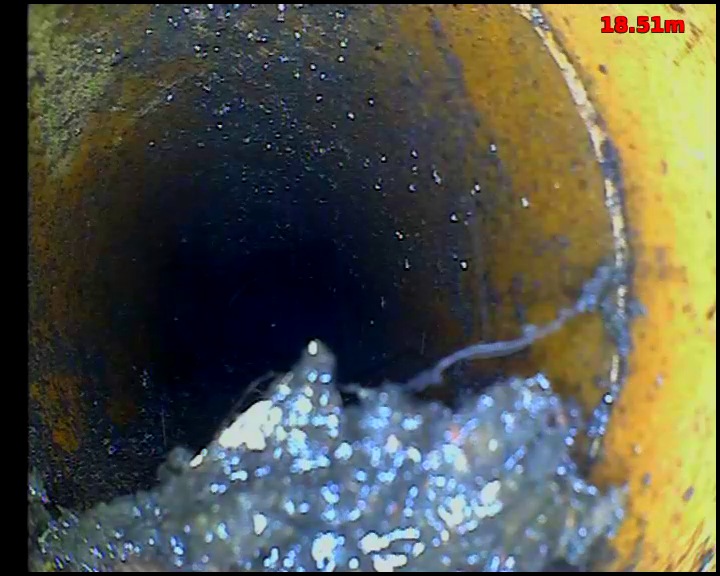
A CCTV drain survey puts a camera through your drainage and produces a record of what is actually down there: every run, every junction, every defect, positioned to the centimetre and coded to the industry standard.
Call 01902 475 611 · Request a survey
When people call us for one
Buying a house. A homebuyer drain survey is the part of a purchase most people skip and the one that can carry the largest unexpected bill. A standard structural survey does not go underground.
A drain that keeps blocking. Repeated blockages are a symptom. Clearing them again treats the symptom; a survey finds the root, the dropped joint or the broken section causing it.
Building over or near a drain. Extensions and garden rooms frequently sit over a shared lateral or a public sewer. Severn Trent will want to know the position, depth and condition of the pipe before agreeing a build-over.
Settling a dispute. Shared drainage between neighbours produces a lot of arguments about who pays. A recorded, graded survey turns opinion into evidence.
What the survey covers
- Every accessible run, manhole to manhole, plus rodding eyes, gullies and soil vent pipes.
- Defects coded to MSCC, positioned in metres from the start of each run.
- A condition grade per section on the Drain Repair Book scale, A to E.
- A site plan of the system, which for most properties has never existed.
- The full video, so you can see the defect rather than take our word for it.
Same-day reporting, by certified surveyors
You get the report the same day: not in a week. If you are mid-purchase with a chain waiting on you, that matters. Surveys are carried out by NADC-certified surveyors and every report carries the surveyor’s certification number, which is what makes the document worth something to a solicitor, an insurer or a water authority.
We do not offer a recommendations section: our reports set out what is there and how bad it is, graded section by section, and leave the remedial decision to you.
Why drains fail in Dudley
Ground conditions decide what fails in a drain and how often, and they vary street by street. Here is what we are working with.
Dudley sits on some of the most heavily worked ground in the country, and it shows up on camera.
Limestone mining, and the ground above it. Dudley’s Wenlock limestone was mined for centuries for ironmaking flux, leaving extensive underground workings beneath the town: the caverns under Castle Hill and Wren’s Nest are the visible part of a much larger network. Borough-wide stabilisation work has been going on for decades. Where ground has moved above old workings, pipe joints move with it. Displaced joints are the defect we log most often across the borough, and they are almost never the householder’s fault.
Coal, as well. The South Staffordshire Thick Coal was worked at shallow depth across Netherton, Woodside and Russells Hall. Same consequence: ground that has settled unevenly over a century, and drainage that was laid assuming it wouldn’t.
Victorian clay with a great many joints. The terraces of central Dudley, Netherton and Kates Hill run on salt-glazed vitrified clay in short lengths, so a single run can carry thirty joints. Every joint is somewhere a root can enter. The interwar and post-war estates, Priory, Wrens Nest, Russells Hall, bring their own problem: pitch fibre, a bitumen-based pipe used through the 1950s to 70s that deforms rather than cracks and is now well past its design life.
That is the reason a repeat blockage here is worth looking at properly rather than clearing again: the cause is usually structural and it is usually visible.
Who owns the drain
Since the 2011 private sewer transfer, Severn Trent owns most shared drainage and everything beyond your boundary. You are responsible for the pipework serving only your property. If a survey shows the problem is past that line, it may be Severn Trent’s to fix rather than yours.
Worth knowing: South Staffs Water supplies Dudley’s drinking water but is not the sewerage undertaker. For a drainage problem, Severn Trent is who you want.
A survey in Dudley
A DY1 property, four separate runs, foul and combined, a mix of vitrified clay and later PVC. Nine defects logged: four points of root ingress, two displaced joints, water infiltration through an opening, a circumferential crack and a hole in the pipe wall. Worst section graded C.
That combination, roots exploiting joints that ground movement has already pulled apart, is the characteristic Dudley pattern.
What actually blocks a drain in Dudley
Almost everything we pull out of a domestic drain falls into a short list, and most of it should never have gone down there in the first place.
Wet wipes. The single commonest cause we attend. They do not break up the way paper does, and once one snags on a rough joint the rest build against it until the bore is gone.
Nappies and sanitary items. They are designed to swell. A drain that will pass one will block on the third.
Fat, oil and grease. Poured down warm, set solid cold. On a DY1, DY2 and DY3 run with any flat section it catches everything that follows.
Roots. Not a housekeeping problem: a structural one. Roots get in through a joint that has already opened, and then behave like a net.
A pipe that is already damaged. If a run blocks repeatedly in the same place, the cause is usually the pipe rather than what went into it.
Recurring blockages: the cheaper order of operations
Clearing the same Dudley drain every few months costs more over a year than finding out why once.
Repeat blockages in one spot almost always have a physical cause. A displaced joint leaves a step for solids to catch on. A length that has lost its fall holds water, and solids drop out of suspension in the flat. A crushed section under a drive does the same.
So: jet it properly rather than rod it, put the camera down while the bore is clear, and get the defect positioned in metres and coded. “There is a problem out the back” is not something anyone can quote against. “Joint displaced medium at 14.2 m, severity 3” is.
Why it only floods when it rains
A drain that copes all week and backs up in a downpour is usually telling you about capacity rather than a blockage.
On combined systems, common across older Dudley property, roof and yard water shares the pipe with everything else. Lose part of the bore to silt, roots or a displaced joint and the run still copes with normal flow, until the rain arrives.
Our surveys record water levels at intervals for exactly this reason: a section holding water where it should be running is a finding, not a detail.
Extending a property in Dudley
Dudley is consistent enough, from Brierley Hill and Coseley outwards, to describe in one go. DY1, DY2 and DY3 are the area meant.
The expensive version of this always runs the same way: plans drawn, quotes accepted, foundations marked out, and then somebody lifts a cover in the middle of where the extension is going.
If you intend to build over a public sewer or lateral drain, or within three metres of one, you need Severn Trent’s agreement. Two things catch people out after the 2011 transfer: the pipe down your own garden may be a public sewer if it serves more than one property, and the length beyond your boundary transferred as well.
They will want to know where the pipe runs, how deep it is, what condition it is in and where the chambers are. That list is a description of a survey with a drainage plan, which is why it is worth doing at design stage rather than after.
Access and site constraints in Dudley
Not every job is a clear driveway and an open chamber, and it is worth saying what we need before we arrive.
Rear access. Terraced streets often have shared entries and no vehicle access to the back. Our equipment comes off the van on foot where it has to, but it changes how long the job takes.
Finding the chamber. Covers get tarmacked over, decked over and turfed over. If you know where yours is, tell us on the phone; if you do not, we will find it, but again it is time.
Parking. On the tighter Dudley streets, somewhere to put the van within hose reach is the practical constraint.
Standing water. The camera cannot see through it, so a blocked run is cleared before it is surveyed.
How quickly we can get to Dudley
Ring us and you will get a realistic time before you commit to anything. The variable is what is already booked in, not the distance. Dudley is inside our unblocking patch and we are through it constantly.
You speak to the person who will do the work, not a call centre, and we will give you a price on the phone before we come out.
Common questions
How long does a survey take? Most domestic properties take one to three hours, depending on the number of runs and how accessible the manholes are.
More questions about CCTV drain surveys
Also in Dudley: Blocked drains and drain unblocking Nearby: Stourbridge · Halesowen · Wolverhampton · Sedgley Coverage: Areas we cover across the West Midlands
More nearby: Blocked drains in West Bromwich · Drain unblocking in Bilston · Blocked drains in Halesowen · Drain unblocking in Stourbridge
Talk to the person who will do the work.
Surveys across the West Midlands, south Staffordshire, east Shropshire and north Worcestershire. Unblocking closer to home.