
01902 475 611: we cover B62 and B63 from our base in Castlecroft.
Halesowen sits in a valley, and it shows in the drainage. Runs are steeper than average in the upper parts around Hasbury and Hayley Green, and flatter than they should be down towards the town centre, which is where things collect.
Ring us and you will get a realistic time. You speak to the people doing the work.
Call now · Request a call back
How we clear it
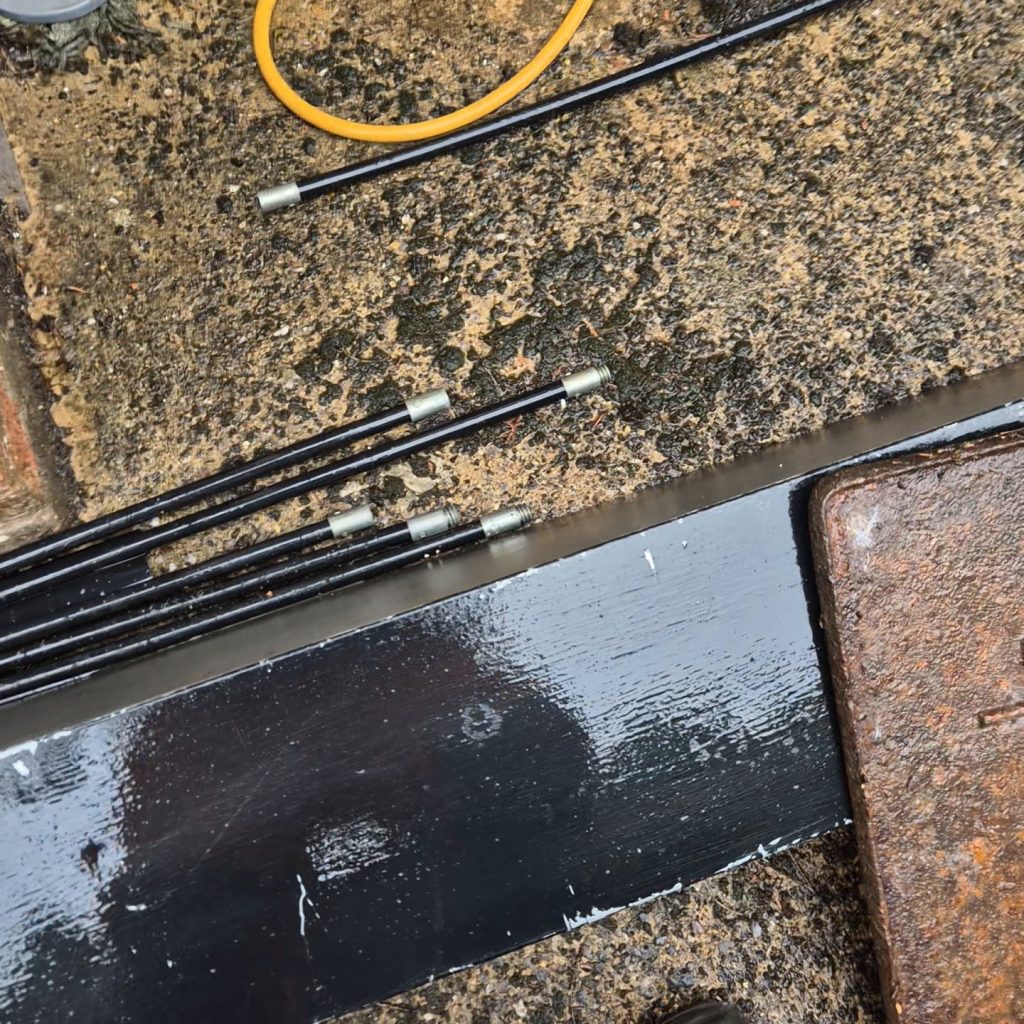
Jetting, not rods. Where a run has too little fall, common in the lower parts of the town, material settles along its whole length, and only jetting takes it back to full bore.
How high-pressure drain jetting works
Why drains fail in Halesowen
Most recurring problems here trace back to ground conditions rather than to anything that was put down the drain. This is why.
Topography does half the work and causes half the problems. The town drops sharply from the Clent and Romsley side down to the Stour valley. Steep runs scour themselves clean; the flat sections they discharge into do not, and that is where silt and fat accumulate. A blockage in Halesowen is very often a long way downstream of the house reporting it.
Surface water arrives fast. Steep catchments deliver rainfall quickly. A run that is 60% blocked will cope all summer and surcharge in the first heavy autumn storm, which is why so many of our calls here cluster after rain.
Victorian clay in the old core, estates around it. Halesowen town centre, Hawne and Cradley run on short-length vitrified clay with a joint every metre or so. Hasbury, Hayley Green and Lapal are largely interwar and post-war: the latter bringing pitch fibre, which goes oval rather than cracking and blocks more and more often as it does.
Mature trees on the good streets. The established planting around Hurst Green, Highfields and Illey sits over old clay. Roots find joints.
All of it shows up on camera and none of it shows from a manhole cover, which is the practical reason a survey is worth more here than an opinion.
If it keeps happening
A drain that blocks repeatedly has a structural cause, and clearing it again treats the symptom. We can put a camera down the same run while we are on site, see CCTV drain surveys in Halesowen.
Who pays
Shared drainage and anything beyond your boundary has belonged to Severn Trent since 2011. In Halesowen this matters more than most places, because with the steep falls the blockage is frequently well downstream of the property that noticed it, and quite possibly not yours at all.
South Staffs Water supplies the water here but not the sewerage.
Areas we cover
Blackheath, Cradley, Halesowen town centre, Hasbury, Hawne, Hayley Green, Highfields, Hurst Green, Illey, Lapal, Quinton, Romsley and Shenstone. B62 and B63.
Drainage for business premises
Halesowen covers a fair spread of housing, from Blackheath, Cradley, Halesowen town centre, and this applies to most of it.
The commercial version of a blocked drain is rarely just a blocked drain: it is a closed kitchen or a yard that cannot be used.
Grease, silt and volume are the three differences from domestic work, and all three respond better to a scheduled jetting and survey than to being left until they stop the site. We work on Halesowen commercial premises on both bases.
New build and warranty issues in Halesowen
Newer housing is not automatically well drained. Drainage goes in early in a build, gets driven over by everything that follows, and settles for years afterwards.
The common findings on recent estates are debris left in the run from construction, sections laid without consistent fall, and connections made after the original work that were never recorded.
Warranty periods are finite. A survey inside that window is worth considerably more than one outside it, because it turns “something is wrong” into a documented, coded, positioned defect that somebody else has to answer for.
Build over agreements around Halesowen
A survey before the drawings are finished is considerably cheaper than a diversion after them.
You cannot normally build over an inspection chamber, access has to be maintained. The options are to redesign around it, relocate it, or divert the run under Section 185 of the Water Industry Act 1991, which obliges the undertaker to divert a sewer where it is reasonably practicable, at the applicant’s cost.
In several of the properties we have surveyed, chambers had been buried by previous landscaping. A chamber nobody knows about is the one that stops a build, so the survey records them explicitly.
We do not carry out diversions or excavation. We produce the plan and the graded report that goes with the application.
What the drains under Halesowen are made of
It matters more than people expect, because the material decides how a drain fails and what putting it right involves.
Vitrified clay. What most pre-1970s drainage here is built from. Durable and chemically inert, but laid in short lengths, so a thirty metre run has twenty or thirty joints, and joints are where ground movement shows up. Across the surveys we have written up, displaced joints account for 35 of the 60 defects recorded.
Pitch fibre. Used from roughly the 1940s to the 1970s. It deforms rather than cracks, going oval under load, so blockages become gradually more frequent rather than arriving suddenly.
Plastic: PVC, polypropylene, polyethylene. Later work and newer estates. Fewer joints, but it can still be crushed, and it settles like anything else.
Why roots keep finding the same drain
If roots have been cleared from a Halesowen drain once and returned, nothing has gone wrong, that is simply what happens when the way in is still open.
Roots enter through an existing defect: an open or displaced joint, a crack, a break. Cutting them out removes the mass but leaves the opening, and the same tree is still looking for the same water.
The useful question is therefore not how to kill the roots but where they are getting in, at what distance along the run, and whether that length is even yours, which is a camera and a plan, not another clearing.
Common questions
How quickly can you get here? Ring us and we will give you a realistic time before you commit to anything. The variable is what is already booked in, not the distance.
What will it cost? We will give you a price on the phone before we come out, so there are no surprises when we arrive.
More questions about drain unblocking
Also in Halesowen: CCTV drain surveys Nearby: Stourbridge · Dudley · Cradley Heath Coverage: Areas we cover
More nearby: Drain surveys in Dudley · Drain unblocking in West Bromwich · Blocked drains in Bilston · Drain unblocking in Willenhall
Talk to the person who will do the work.
Surveys across the West Midlands, south Staffordshire, east Shropshire and north Worcestershire. Unblocking closer to home.