
If your drain is blocked, the first question is not who to call. It is whose pipe it is — because for a great many blockages the answer is Severn Trent, and they will come out and clear it at no charge.
A lot of people pay for work on a pipe they do not own.
Call 0800 772 33 99 · Request a call back
What changed in 2011
On 1 October 2011, in England and Wales, most private sewers and lateral drains that were connected to the public sewerage system transferred into the ownership of the regional water and sewerage company. In our area that is Severn Trent.
The transfer covered pipes already in existence on 1 July 2011. Private pumping stations followed later, transferring by October 2016. Anything built after that date is a separate matter, normally dealt with through an adoption agreement when the development is built.
The point of the change was that hundreds of thousands of householders were unknowingly jointly responsible for shared pipes running under other people’s gardens, with no practical way to organise a repair.
The three words that decide it
The rules turn on which of three things your pipe is. The distinction is not intuitive, so it is worth getting straight.
A drain serves one building only. The section inside your property boundary is yours — you own it and you maintain it.
A lateral drain is the continuation of that same pipe beyond your property boundary, still serving only your house, until it meets the public sewer. Despite serving only you, this transferred in 2011. It is Severn Trent’s.
A sewer serves more than one property. If your pipe joins with next door’s before either reaches the main, that shared section is a sewer — and it transferred too, even where it runs under your own garden.
So the practical test is two questions: does it still only serve my house, and is it still inside my boundary? If the answer to both is yes, it is yours. If either is no, it is very probably Severn Trent’s.
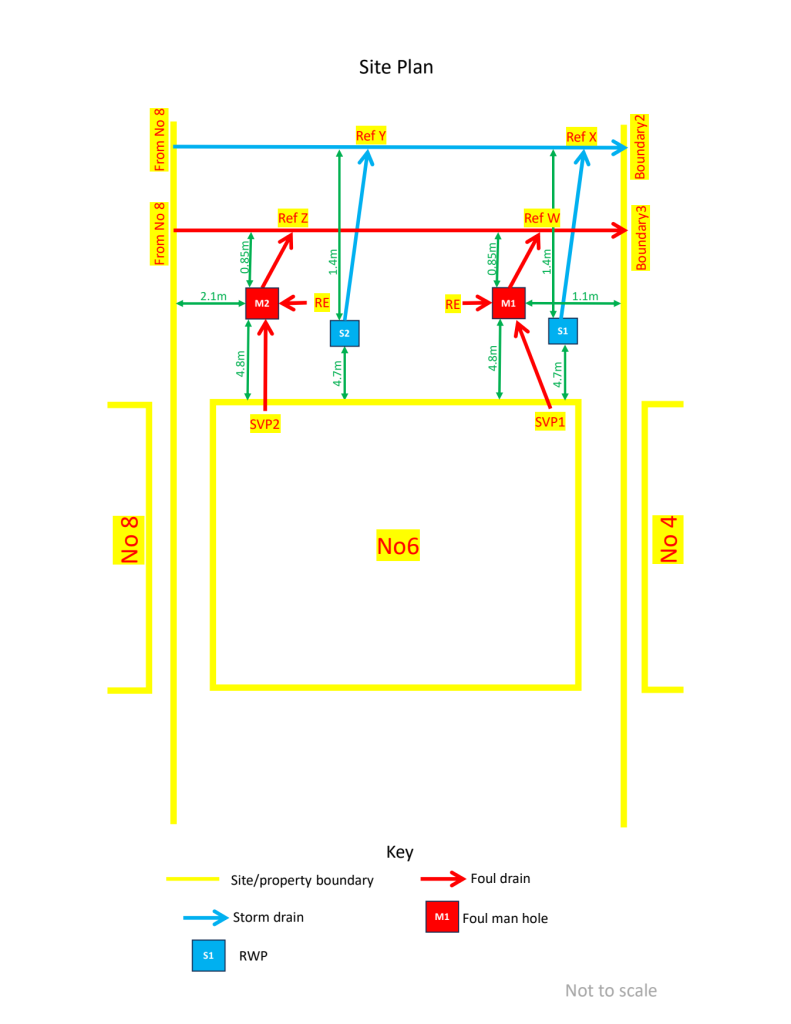
Where this bites in practice
The most common domestic layout is a run from the house to a chamber near the boundary, then out to the main in the road. Blockages happen most often at the far end, where the fall is shallowest and where the pipe joins something larger — which is frequently past the boundary, and therefore not your pipe.
Our own survey data shows why the far end matters: displaced joints are 35 of the 60 defects we have recorded, and joints open up where ground moves and where pipes change direction. A blockage sitting against a displaced joint will keep coming back until the joint is dealt with, whoever owns it.
How to tell before you pay
- Lift the chamber cover nearest your boundary. If it is holding water, the blockage is downstream of that chamber — likely the lateral drain, likely not yours. If that chamber is clear and the one nearer the house is full, the problem is on your length.
- Ask whether anyone else’s waste passes through. If a neighbour’s pipe joins before yours reaches the main, that shared section is a sewer.
- Call Severn Trent first if it looks like theirs. They attend blockages on their own assets without charge. There is nothing to lose by asking.
- Do not assume the deeds settle it. Ownership changed by statute in 2011; older deeds and plans often still show the pre-transfer position.
Where a survey helps and where it does not
A camera survey will not tell you who owns a pipe — ownership is a legal question, not something visible on film. What it does is establish the facts the question depends on: where the run goes, where the boundary falls relative to the chambers, where other pipes join, and where the defect actually is. Our reports position every observation to the centimetre and record every junction and connection, which is normally enough for Severn Trent or a solicitor to reach a view.
If the pipe turns out to be yours and the defect is structural, you will want the grades and codes as well — see what the grades mean.
The exceptions worth knowing
Not connected to the public sewer? If your drainage runs to a septic tank, treatment plant or cesspool, none of this applies. The whole system is private, including the pipework. (Soakaway and percolation testing is a separate business run by the owner’s brother — see percolation tests.)
Private roads and unadopted land. Some pipes in these situations did not transfer. They are less common but they exist.
Anything built since July 2011. Newer estates are usually covered by an adoption agreement rather than the transfer.
Your own gullies, and the pipe under your house. Still yours, in every case.
Talk to the person who will do the work.
Surveys across the West Midlands, south Staffordshire, east Shropshire and north Worcestershire. Unblocking closer to home.