
We survey across WV12 and WV13 – Willenhall, Bentley, New Invention, Short Heath, Lane Head, Portobello, Little London and Wood End.
A CCTV drain survey puts a camera through your drainage and produces a record of what is actually there: every run, every junction, every defect, positioned to the centimetre and coded to the industry standard.
Call 0800 772 33 99 · Request a survey
What you get
Here the site plan often matters as much as the defects, because shared runs are the norm rather than the exception. Every section is graded, every defect coded to MSCC and positioned in metres, with a site plan and the full video. The report comes back the same day, by NADC-certified surveyors.
What a CCTV drain survey covers
Why people here ask for a survey
Settling who owns what. Shared drainage produces a great many arguments about who pays. A recorded survey turns opinion into evidence.
No record of where anything runs. For a good many properties here the site plan the survey produces is the only accurate drawing of the drainage that has ever existed.
All the reasons a CCTV survey gets commissioned
Why drains fail in Willenhall
Ground conditions decide what fails in a drain and how often, and they vary street by street. Here is what we are working with.
Dense terraces, shared drainage. Willenhall was built around its lock trade, quickly and tightly. The result is short, shallow, short-length clay runs that frequently serve more than one property. For a buyer, the most useful thing a survey produces here is often the site plan – because until it exists, nobody knows which pipe belongs to which house.
Shallow coal and infilled industrial ground. Both are common under the town, and both produce uneven settlement. Displaced joints follow, and they are the defect we log most often.
Pitch fibre on the estates. Bentley, New Invention and Short Heath were built through the pitch fibre era. It cannot be repaired in place, so identifying it before you buy changes what any future problem is going to cost.
Shallow runs. A lot of Willenhall drainage sits closer to the surface than you would expect, which makes it more vulnerable to loading from driveways, extensions and parked vehicles – and worth checking if any of those are planned.
That is the reason a repeat blockage here is worth looking at properly rather than clearing again – the cause is usually structural and it is usually visible.
Who owns the drain
Since the 2011 private sewer transfer, Severn Trent owns shared drainage and everything past your boundary. With the number of shared runs in Willenhall, working out where your responsibility ends is one of the more valuable things a survey settles.
South Staffs Water supplies the water here but not the sewerage.
What actually blocks a drain in Willenhall
Bentley and Lane Head are a fair sample of Willenhall drainage, and what follows is what we find across WV12 and WV13.
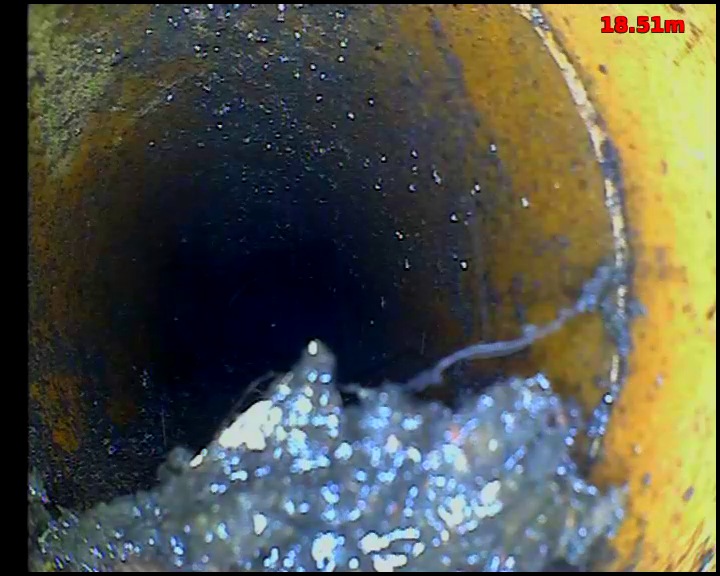
Almost everything we pull out of a domestic drain falls into a short list, and most of it should never have gone down there in the first place.
Wet wipes. The single commonest cause we attend. They do not break up the way paper does, and once one snags on a rough joint the rest build against it until the bore is gone.
Nappies and sanitary items. They are designed to swell. A drain that will pass one will block on the third.
Fat, oil and grease. Poured down warm, set solid cold. On a WV12 and WV13 run with any flat section it catches everything that follows.
Roots. Not a housekeeping problem – a structural one. Roots get in through a joint that has already opened, and then behave like a net.
A pipe that is already damaged. If a run blocks repeatedly in the same place, the cause is usually the pipe rather than what went into it.
Access and site constraints in Willenhall
It varies street by street in Willenhall, but WV12 and WV13 follows a recognisable pattern and Bentley and Lane Head are typical of it.
Not every job is a clear driveway and an open chamber, and it is worth saying what we need before we arrive.
Rear access. Terraced streets often have shared entries and no vehicle access to the back. Our equipment comes off the van on foot where it has to, but it changes how long the job takes.
Finding the chamber. Covers get tarmacked over, decked over and turfed over. If you know where yours is, tell us on the phone; if you do not, we will find it, but again it is time.
Parking. On the tighter Willenhall streets, somewhere to put the van within hose reach is the practical constraint.
Standing water. The camera cannot see through it, so a blocked run is cleared before it is surveyed.
What the camera actually shows
Bentley and Lane Head and the rest of Willenhall share the same drainage story, so it is worth telling once. WV12 and WV13 are the ground being described.
A survey is not a torch down a hole. The camera is fed the length of the run and every observation is recorded against a distance from the start.
Displaced joints show as a step or a crescent of shadow where the far pipe no longer lines up with the near one.
Open joints show a dark band all the way round, sometimes with soil visible behind.
Roots appear as fine fibres trailing in the flow, or a dense mass filling the bore – nearly always at a joint you can see behind them.
Cracks are break lines that are not visibly open, recorded by clock position.
Infiltration is water entering where no connection exists.
Every one of those carries a still image in the report, so you can see the thing being described rather than take a code on trust.
What it costs
Willenhall covers a fair spread of housing, from Bentley, Lane Head, Little London, and this applies to most of it.
You get a price on the phone before we come out, so there are no surprises when we arrive.
We do not carry out repairs, relining or excavation. That is worth knowing when you are comparing quotes, because most firms who survey your drains also quote for fixing them
- and when a survey says a section is failing, they are the ones who benefit. We are
not, which is also why we are comfortable telling you when a survey comes back clean.
If the blockage turns out to be on Severn Trent’s side of the boundary, we will say so rather than invoice you for it.
Surface water, foul, or both?
Bentley and Lane Head are a fair sample of Willenhall drainage, and what follows is what we find across WV12 and WV13.
Worth knowing which system you are dealing with, because it changes who is responsible and what a blockage means.
Foul takes waste from the house. Surface water takes rain from roofs and hard standing. Combined takes both, which is what a great deal of older Willenhall drainage does.
A gully overflowing only in heavy rain points at the surface water side, or at a combined run that has lost capacity. A toilet backing up in dry weather points at the foul side. Our reports record the use of every section, because a wrong connection – foul into surface water, or the reverse – is a finding in its own right.
Common questions
Whose drain is it? That is exactly what the survey and the site plan establish — and since 2011 a good deal of shared pipework has been Severn Trent’s, not yours.
More questions about CCTV drain surveys
Also in Willenhall: Blocked drains and drain unblocking Nearby: Wolverhampton · Walsall · Bilston Coverage: Areas we cover
Talk to the person who will do the work.
Surveys across the West Midlands, south Staffordshire, east Shropshire and north Worcestershire. Unblocking closer to home.