
If the same drain has blocked twice in a season, the blockage is not really the problem. Something about that pipe is catching material that ought to pass straight through, and until that is found you are paying to clear the same drain repeatedly.
Call 01902 475 611 · Request a call back
What rodding actually does
Rods are mechanical. You push a hole through the obstruction, flow returns, and the water goes away. It is quick and on a simple soft blockage it is often all that is needed.
But consider what is left behind. A 100 mm pipe, which is what most domestic drainage round here is, with a 30 mm hole rodded through a mass of accumulated material is technically flowing. It is also carrying a fraction of its capacity, with the rest of the obstruction still sitting there ready to catch the next thing that comes down. That is the three-week blockage.
Rods also cannot get everywhere. They travel poorly around bends, they follow the easiest route rather than the one you intend, and at a junction they will happily go up the branch instead of along the run.
What jetting does differently
High-pressure water jetting works on the whole bore rather than a line through the middle of it. The nozzle is fed down the pipe and the jets scour the wall as it is drawn back, taking the pipe back towards its actual diameter rather than a channel through the blockage.
It also follows the pipe. A hose goes round bends that rods will not, travels the full length of the run, and can be worked back and forth over a specific spot.
The trade-off is that jetting has to be matched to the pipe. On old or fragile pipework (a badly cracked clay run, or a deformed pitch fibre one) full pressure into a weak spot is not a good idea, and pressure and nozzle choice matter. That is a judgement made on site, ideally with a camera to hand.
Why it comes back: the structural reasons
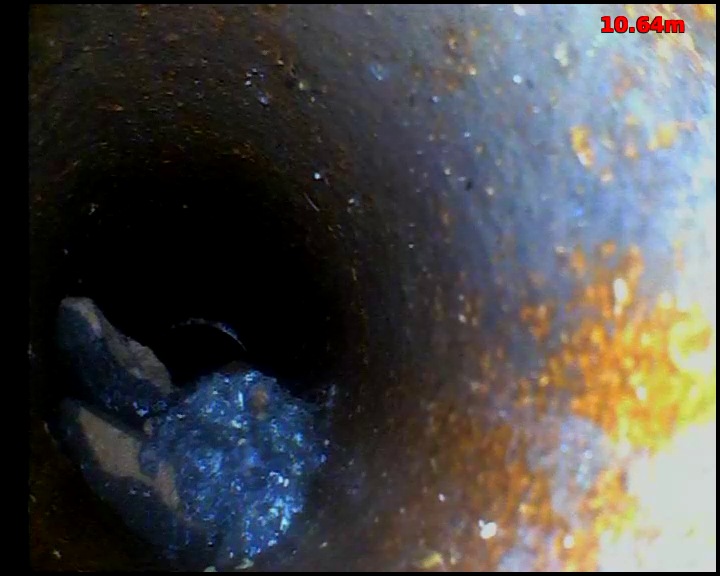
A pipe that repeatedly blocks in the same place normally has a reason, and the reasons are not exotic. From our own survey records, across every defect logged:
| What we find | Share of all defects |
|---|---|
| Displaced joints | 35 of 60 |
| Cracking | 12 of 60 |
| Root ingress | 8 of 60 |
| Holes, infiltration, lining defects | 5 of 60 |
A displaced joint is a step in the pipe. Where the pipe has moved across its own axis, one edge stands proud of the other, and everything travelling down the pipe catches on it. Our reports grade these by how far they have moved relative to the wall thickness, between one and one and a half times is a “medium” displacement, more than that is “large”.
Roots are the other classic. They do not drill through sound pipe; they find a way in that already exists. As the guide in the back of our reports puts it, roots normally infiltrate via bad joints, cracks, fractures and breaks. Once in, a root mass behaves like a filter, water passes, everything solid does not.
Fall and standing water. If a length has settled so it no longer falls consistently towards the sewer, solids drop out of suspension in the flat spot. Our surveys record the water level at intervals precisely because a section holding water where it should be running is a finding in itself.
The cheaper order of operations
The instinct after a second blockage is to clear it again. The better move:
- Clear it properly, jet it rather than rod it, so the pipe is back to full bore and the camera has something to look at.
- Put a camera down the same run in the same visit. Standing water hides everything, so the survey is only worth doing on a clear pipe.
- Find out whether it is even your pipe. Repeat blockages near the boundary are very often on the lateral drain, which since 2011 belongs to Severn Trent, see who owns your drain. They clear their own assets at no charge.
- Get the defect coded and positioned. “There’s a problem somewhere out the back” is not something anyone can quote against. “Joint displaced medium at 14.2 m, severity 3” is.
We do both halves of that, the jetting and the survey, and we do not do the repairs, so there is no version of this where finding more work in your drain benefits us.
When repeat blocking is not structural
Worth saying, because not everything is a defect:
- Wipes and fat. Nothing wrong with the pipe; the wrong things are going into it. A survey will show a clean bore and settle the argument.
- A shared run. If a neighbour’s waste joins yours, their habits are your blockages. That shared section is also probably a public sewer.
- A collapsed or crushed section under a driveway where something heavy has been parked since the pipe was laid. That one is structural, and it is a survey job.
Related: High-pressure drain jetting · Blocked drains · Roots, joints and old clay
More guides: Build over agreements and Section 185 diversions · How to tell pitch fibre from clay, and why it matters
Talk to the person who will do the work.
Surveys across the West Midlands, south Staffordshire, east Shropshire and north Worcestershire. Unblocking closer to home.