
Two houses on the same street, built ten years apart, can have drainage made of completely different materials, and the difference decides whether a defect is a morning’s work or a new pipe. Pitch fibre is the one that catches people out, because it fails in a way clay never does.
Call 01902 475 611 · Book a CCTV survey
What pitch fibre actually is
Pitch fibre pipe is made from wood cellulose impregnated with coal tar pitch. It is not ceramic and it is not plastic. It was used across British housing from roughly the 1940s to the 1970s, because it was light, cheap and quick to lay: a single length could span what would otherwise need several clay pipes and several joints.
That lightness is the whole problem. Clay is rigid and brittle: it holds its shape until something breaks it. Pitch fibre is comparatively soft, and under the weight of ground above it (or a driveway, or a car) it slowly loses its round shape.
How the two fail differently
This is the part that matters, because it changes what a defect means.
Clay fails at its joints. It comes in short lengths, so a run has many joints, and joints move as ground settles. In our own surveys, displaced joints are far and away the most common defect: 35 of the 60 defects we have recorded are displaced joints, against 12 cracks and 8 instances of root ingress. A displaced joint is usually a local problem in a local place.
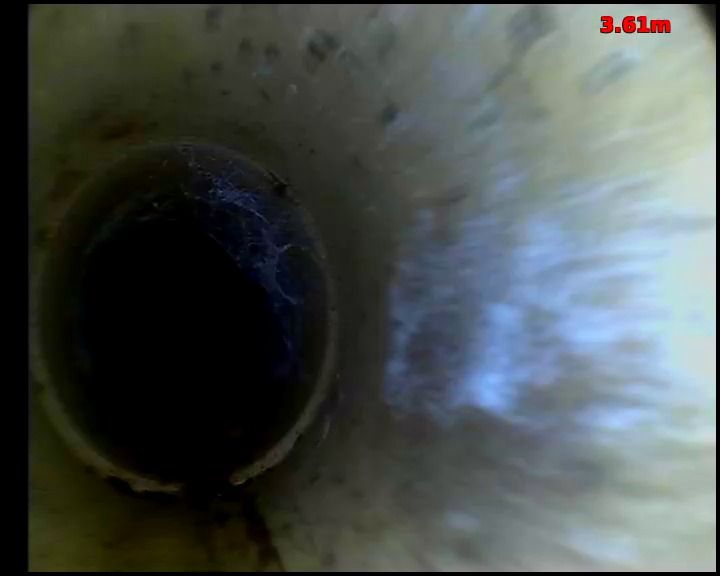
Pitch fibre fails along its length. It deforms, goes oval, then blisters, then delaminates as the layers separate. By the time it is visible on camera, the deformation typically runs for metres, not centimetres. There is no single joint to point at.
Telling them apart on camera
A survey settles it in seconds, but here is what the surveyor is looking at:
| Vitrified clay | Pitch fibre | |
|---|---|---|
| Colour | Buff, red-brown or grey, often glazed and shiny | Dark brown to black, matt |
| Joints | Every 600 mm to about 1.6 m | Few, long unjointed lengths |
| Cross-section | Round, and stays round | Oval or pear-shaped where it has deformed |
| Typical defect | Displaced or open joint, cracking | Blistering, delamination, loss of shape |
| Surface | Hard, smooth, can be chipped | Can look layered or flaking where it has failed |
Age of the house is a reasonable first guess but not proof. Estates built in the 1950s and 60s are the usual candidates, and later additions to an older property may be pitch fibre while the original run is clay. A change of material partway along a run is common enough that our reports carry a specific code for it. MC, material of drain or sewer changes.
What we actually find round here
Worth being straight about this, because plenty of drainage websites imply pitch fibre is everywhere.
Across the surveys we have written up, we have not recorded pitch fibre once. The material we record most is vitrified clay, 31 of the pipe runs in those reports, followed by polypropylene, polyethylene and a single run of PVC. The Black Country and south Staffordshire housing we survey is mostly clay, and mostly 100 mm bore.
That does not mean pitch fibre is not out there. It means that if you are buying on a post-war estate and want to know what you are buying, the answer is worth establishing rather than assuming, in either direction.
Why it changes the cost
A displaced clay joint is a defect at a point. Depending on severity it may be something to monitor, something to note, or something to put right in one place.
Deformed pitch fibre is a condition of the whole pipe. It is generally not a patching job: the remedies are relining or replacement, and both are priced by the metre. That is the reason it is worth identifying before you exchange contracts rather than afterwards.
We do not carry out repairs, lining or excavation, so we have nothing to gain from telling you a pipe needs replacing. The survey tells you what is there, graded and coded, and you take that to whoever does the work.
What to do with the answer
If a survey identifies pitch fibre:
- Get the extent, not just the fact. How many metres, and on which runs. That is what any quote will be priced against.
- Check who owns it. If the deformed length is beyond your boundary it may not be your pipe at all, see who owns your drain.
- Ask for the footage, not just the report. Deformation is much easier to understand seen than described.
If it is clay, the question becomes the joints, and that is a different piece: roots, joints and why old clay fails.
Related: Homebuyer drain surveys · CCTV drain surveys · Drainage advice
More guides: What a homebuyer drain survey actually finds · What the grades mean when your report says Grade C
Talk to the person who will do the work.
Surveys across the West Midlands, south Staffordshire, east Shropshire and north Worcestershire. Unblocking closer to home.