
We survey across B90 to B94 from our base in Castlecroft, Wolverhampton. Every section graded, every defect coded to MSCC, a site plan, the full video, and the report back the same day, by NADC-certified surveyors.
Call 01902 475 611 · Request a survey · What a survey covers
Why drains fail in Solihull
What is under the ground matters more than the age of the house. These are the conditions behind most of what we find here.
Interwar and post-war suburbia on clay ground. Solihull is largely 1920s to 1960s housing on Mercia Mudstone: a shrinkable clay that moves with the seasons. Ground that moves takes drainage with it, and displaced joints are overwhelmingly what we find here: in one Solihull survey, fourteen of the seventeen defects logged were displaced or open joints.
Mature planting over ageing clay pipework. Knowle, Dorridge and Bentley Heath put established gardens over runs laid eighty or ninety years ago. Where a joint has already opened through ground movement, roots follow. What that causes: short pipe lengths and a great many joints, and it is the joints rather than the pipe that move.
Which is why we would rather put a camera down the run than tell you what is probably wrong with it.
Why people here ask for one
Most often it is a drain that keeps blocking, or buying a property. All the reasons a survey gets commissioned
Surveys in Solihull
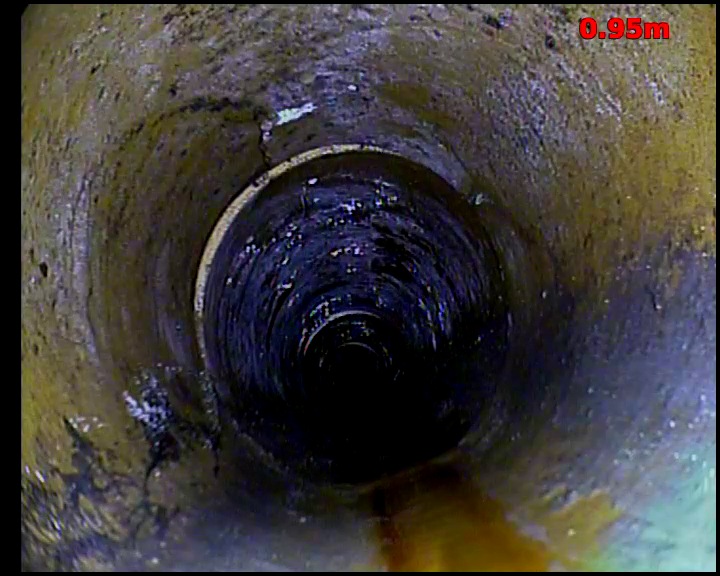
Two Solihull properties, three runs each. The first logged seventeen defects (fourteen of them displaced or open joints, plus three cracks) with the worst section graded C. The second, in B91, came back with root ingress and a single displaced joint on one run.
The pattern is consistent with shrinkable clay ground: joints open first, roots follow.
Areas we cover
Balsall Common, Bentley Heath, Dorridge, Hampton in Arden, Knowle, Olton, Shirley, Solihull town centre and Sparkhill. B90 to B94.
Solihull sits inside our survey radius but outside our drain unblocking radius, so we cover it for planned survey work rather than emergency call-outs.
A question we get asked here
What does a displaced joint actually mean for me? A step in the pipe where solids catch. One or two are common; a run with a dozen will keep blocking whatever anyone does to it, and jetting is a holding measure.
Pipe material, and why we record it
Every section in our reports names the material, because it is the first thing any repair quote will turn on.
Vitrified clay dominates older Solihull drainage. Short lengths, many joints, and the joints are the weak point rather than the pipe.
Pitch fibre appears on post-war estates. It deforms along its length instead of cracking at a point, so it is a whole-run problem when it goes.
Modern plastics are on newer work. Better in most respects, but not immune: they crush under load and settle in made ground like anything else.
What we pull out of drains around Solihull
The blockage itself is rarely a mystery. It is nearly always one of five things.
Wipes, marketed as flushable. They are not. They keep their structure in water, and they are the first thing we look for.
Sanitary products and nappies. Both swell on contact. Both are common enough that a family home in B90, B91 and B94 will meet the problem sooner or later.
Cooking fat. It leaves the sink as liquid and arrives in the drain as a solid. Where a run is shallow or has lost its fall, it builds into a plug.
Root ingress. Mature trees and a joint that has moved are all it takes.
Structural damage. A displaced joint or a crushed section catches solids on every flush, and no amount of clearing fixes that.
Reading a survey of your Solihull drainage
Solihull is consistent enough, from Balsall Common and Bentley Heath outwards, to describe in one go. B90, B91 and B94 are the area meant.
Reports confuse people because they mix two kinds of entry and only one is a problem.
Observations describe what is there: a junction, a chamber, a change of pipe material, the water level. In our surveys these outnumber defects by roughly three to one, and a tidy system with nothing wrong still generates a page of them.
Defects describe something wrong, and carry a severity. It is the severity, not the presence of a code, that matters.
Across every section we have graded, two thirds came back at the top grade. A long report is not automatically bad news.
Buying a house in Solihull
A standard homebuyer’s or building survey does not go underground. Your surveyor will lift an accessible cover and comment on what is visible from the surface. Nobody puts a camera down the pipe unless you ask.
That is the gap. Drainage is invisible from the surface, expensive to put right if it is structural, and not something you can renegotiate after completion.
On Solihull property the specific questions worth answering before exchange are what the pipe is made of, whether the runs are shared with neighbours, and whether anything has been built over them. All three are routine on a survey and all three cost money to discover afterwards.
Getting to the drain
Most of the variability in a drainage job is access rather than the drain itself.
Older Solihull housing tends to mean shared entries, rear yards without vehicle access, and chambers that have been built over or landscaped out of sight. None of it is a problem
- it is simply the difference between a short visit and a longer one, and it is the
part we would rather discuss on the phone than discover on arrival.
Tree roots and Solihull drainage
It varies street by street in Solihull, but B90, B91 and B94 follows a recognisable pattern and Balsall Common and Bentley Heath are typical of it.
Roots do not break into a sound pipe. The guide printed in the back of our own survey reports puts it plainly: roots normally infiltrate via bad joints, cracks, fractures and breaks. The defect comes first and the root exploits it.
What a root is looking for is water, and a drain leaking at a joint into dry summer soil is an obvious source. A hair root finds the gap, and once inside, in a constant supply of exactly what it wants, it thickens. The root that got in through a two millimetre gap becomes a twenty millimetre root and levers the joint further apart.
Inside the pipe it behaves like a net. Water passes through it. Paper, fat and solids do not. From the house everything seems fine until the day it is not.
Nearby: Birmingham · Redditch · Sutton Coldfield Coverage: Areas we cover across the West Midlands
Case studies: Survey in Solihull: root ingress
More nearby: Blocked drains in Halesowen · Drain unblocking in West Bromwich · Drain surveys in Dudley · CCTV surveys in Walsall
Talk to the person who will do the work.
Surveys across the West Midlands, south Staffordshire, east Shropshire and north Worcestershire. Unblocking closer to home.